
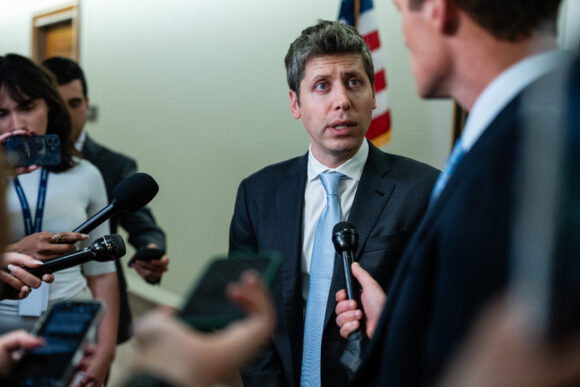
OpenAI Chief Executive Officer Sam Altman plans to brief the Trump administration and U.S. lawmakers next week on the upcoming generation of artificial intelligence models as the U.S. works to create a process to review the safety of cutting-edge AI systems, according to a senior company executive.
Altman’s visit will come as U.S. officials develop a framework for safety reviews that’s expected to be completed in the next few weeks, Chris Lehane, OpenAI’s head of global public affairs, said on Tuesday. He said that part of Altman’s meetings will focus on the company’s new family of models, including how they will affect work.
“We think that there’s going to be some really interesting capabilities with this model family, particularly as it relates to work and scaling work,” Lehane said at a briefing in Washington.
Lehane spoke days after Chinese startup Moonshot released a new model that rivals top offerings from U.S. developers, including OpenAI and Anthropic PBC, raising new questions about the durability of the U.S. lead over China in AI. Moonshot’s Kimi K3 model cast doubt on whether hundreds billions of dollars of investments in infrastructure would bear fruit as hoped, rattling Wall Street investors and spurring a selloff in technology stocks.
Related: Insurer Interest in AI Exclusions Growing as Risk Becomes Omnipresent
In his remarks, Lehane emphasized that the U.S. needs a more comprehensive AI strategy to compete with China, where authorities have adopted a national approach toward development of the emerging technology. Moonshot’s new model highlights the need for the U.S. to establish a coherent nationwide standard, in part to ensure the integrity of cyber defenses, he said.
“It’s really important that there is a process in place to be able to ensure that we’re getting our leading models” out so cybersecurity specialists can have access, Lehane said, adding that applied to U.S. allies as well.
The Trump administration is considering whether to create an independent regulator that would vet AI models with industry input, including a plan that Treasury Secretary Scott Bessent helped develop, which would offer AI companies more certainty about the review process. The proposal resembles one outlined last week by Google DeepMind chief executive officer Demis Hassabis, who will be meeting with policymakers in Washington this week to lobby for his vision.
Related: Clyde & Co Survey Shows Rapid Escalation of AI, Geopolitical Risks
The discussions follow Silicon Valley complaints about the ad-hoc nature of recent U.S. moves to rein in new models. Last month, Anthropic was hit with U.S. export controls that led it to temporarily disable its Fable 5 and Mythos 5 systems. Though OpenAI never faced those public measures, it made significant changes at the government’s request before releasing its latest GPT-5.6 models.
In the absence of a national standard for AI governance, Lehane said he would work to get individual states to align on a single approach. He said that OpenAI was lining up behind a proposal in Massachusetts that calls for the biggest AI developers to take more steps to identify catastrophic risks, a measure also supported by Anthropic.
“If you can’t get Congress to create those national standards,” he said, “the other path to get there is what we call reverse federalism, which is you work with these different states to be able to mirror one another.”
Top photo: OpenAI CEO Sam Altman speaks with members of the media on Capitol Hill in Washington on June 3. Bloomberg.
Was this article valuable?
Here are more articles you may enjoy.
 Tesla Faces Probe Over Claim of Robotaxis Speeding in School Zones
  Hurricane Isaias Reaches Category 3 as It Nears Florida, Alabama
  Will California’s New Smoke Claims Law Create a Recovery Bottleneck?
  TikTok Accused by NY of Running Secret Safety Tests on Teens
Want to stay up to date?
Get the latest insurance news
sent straight to your inbox.