
Increasing natural catastrophe risks worldwide are making insurance harder to obtain, driving nonrenewals and putting pressure on home values — a trend expected to worsen over the coming decades, according to a new study.
It was just a year ago, for example, that Miami and Naples in Florida saw median home prices outpace the national average. Starting earlier this year, Miami’s market flattened and Naples saw price growth fall 8.3%.
One reason, according to the data provider which amassed those figures, is that the balmy metropolises are two of the top three cities in the U.S. with the most homes exposed to “triple threat” natural perils simultaneously over the next 30 years. Houston is the third city on the list.
The term “triple threat” refers to homes exposed to three natural hazards, which can include hurricane winds, wildfire and inland flooding.
Cotality’s report, Weather rewrites home value, examines properties in the U.S. and Australia. The report argues that historical weather patterns are becoming less reliable predictors of future risks, changing how insurers assess properties and how homeowners value them.
“Historical patterns no longer offer a reliable baseline for what’s to come,” the report states.
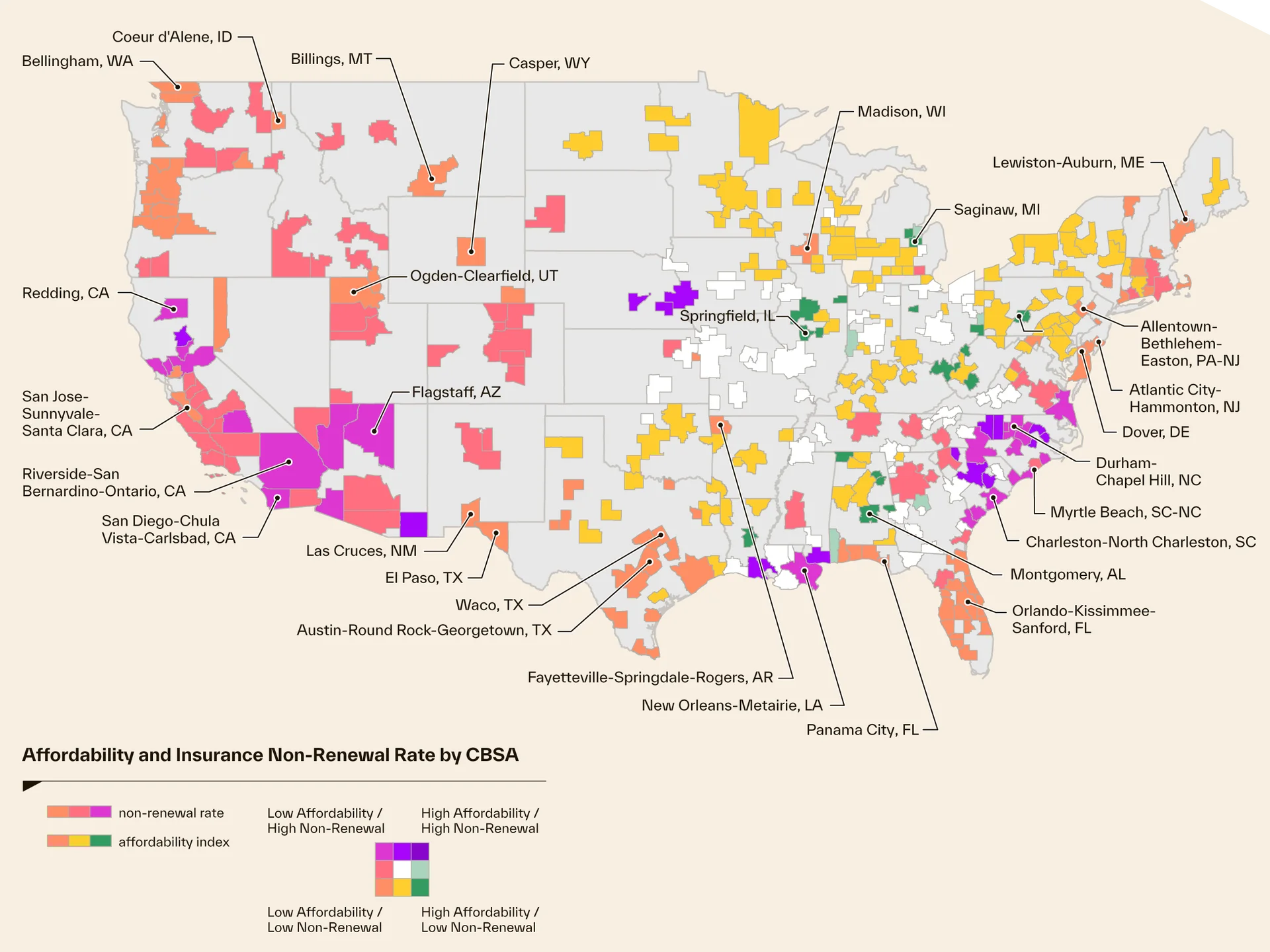
The relationship between historical weather patterns and future risks will become increasingly uncertain heading into 2040, according to the analysis.
California is facing similar pressures. Cotality projects annual wildfire losses reaching $54 million in Nevada County over the next 15 years. In Lake County, the insurance nonrenewal rate reached 7.6% in 2023. The report also notes that California has experienced negative home-price growth in 2026.
Denise Moore, a Cotality research and development principal who authored the report, said more attention should be paid to “the forgotten peril,” severe convective storms, which are not only adding to the risk in new places, but are raising costs for homeowners.
“When you have your roof beat by hail every year and your premium only covers up to a certain amount, you’re then paying out of pocket and you’re paying out of pocket every year, and that could outpace your equity that you’re building in your home,” Moore said.
Related: Tornado Alley’s on the Move and Creating New Risk Concerns, Modeler Says
Hailstorms drove record insured damages as severe convective storms have become more common and damaging, including in places where they were previously less prevalent. Even storms producing small hailstones have created unexpected threats, a report from Allianz in April showed. According to Allianz, SCS events amounted to $60 billion in insured losses in 2025, or nearly half of all insured natural catastrophe losses.
In the middle of the country, where severe convective storms have become a bigger peril, premiums are on the rise, the Cotality report shows.
In Winkler, Texas, for example, nearly one-quarter of homeowners had their insurance policies dropped, according to Cotality. In Kiowa County, Oklahoma, $1.4 million in additional annual storm losses is projected by 2040. Cotality also reports that increases in insurance premiums and deductibles there are outpacing annual gains in home equity.
“When you ask people where weather is hurting home values, they say Florida or California. They don’t say Ohio, Indiana or Michigan,” said Anand Srinivasan, vice president, head of research and development for Cotality. “But across the Midwest, about 9.5 million homes are in counties where severe storm risk is projected to jump by 2040.”
The report also identifies areas where property values have declined alongside increasing insurance pressures, although it does not establish that nonrenewals caused the price declines.
In Dare County, North Carolina, 13% of property insurance policies weren’t renewed in 2023, while home values fell roughly 10%, according to Cotality. By 2025, home-price growth had turned negative.
In Australia, Lismore, Mullumbimby and Ballina experienced flooding in 2022. The three towns remain roughly 5% below their pre-flood property values, according to the report.
However, coastal southeast Queensland, which also experienced flooding, recovered within months and now has property values 31% above pre-flood levels. Cotality attributes the different recoveries in part to stronger housing demand in Queensland, illustrating how natural hazard exposure can have different effects on property markets.
Was this article valuable?
Here are more articles you may enjoy.
 Navigating the Storm: A Claims Manager’s Guide to Class Action Exposure, Coverage and Reserves
 Berkshire’s Pivot to AI Bets Gets an Immediate Reality Check
 White Workers Claiming Discrimination Complicates Shell’s DEI Drive
 Learjet Parts Found Miles From Florida Crash Site, NTSB Says

Want to stay up to date?
Get the latest insurance news
sent straight to your inbox.