
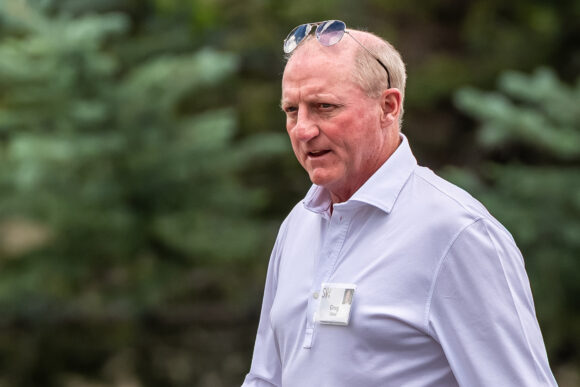
In his first year as Chief Executive Officer of Berkshire Hathaway Inc., Greg Abel has pushed the conglomerate into an entirely new area of investment: artificial intelligence.
In a significant departure from Warren Buffett’s famous reservations about technology stocks, the new CEO started cutting checks soon after he took on the job. In just a few months, he handed $10 billion to Google parent Alphabet Inc. to support its AI-related investments and plowed another $930 million into Bending Spoons SpA, an Italian conglomerate that uses the technology to transform businesses.
But with cracks in the AI trade starting to show, Berkshire’s sudden push may appear ill-timed.
“I do think that part of this may be a conscious decision to increase their exposure,” said Cathy Seifert, an analyst for CFRA Research. “One has to ask the question though, is it a little late?”
Since June, Alphabet’s Class A and Class C shares have tumbled more than 24% and are now trading below the discounted price at which Berkshire acquired them — prompting some to wonder whether its bet on the firm is a stinker. And while Bending Spoons’ stock surged after Berkshire added to its initial investment, the enthusiasm was short-lived: The stock has fallen over the past three weeks.
Related: As AI Laws Proliferate, Liability and Coverage Questions Multiply
Still, for dedicated value investors and longtime Berkshire observers, such jitters may not really matter. After all, Buffett’s 2016 investment in Apple Inc., derided at the time as being late in the iPhone maker’s history, turned out to be one of Berkshire’s most lucrative bets. Abel likely views Berkshire’s AI investments as a long-term wager on the technology’s potential, said Meyer Shields, an analyst for Keefe Bruyette & Woods.
“He’s not trying to send a message to the markets,” said Shields. The CEO “can consider these investments with all the conservatism that you would expect at Berkshire Hathaway.”
And given AI’s massive investment needs in the years to come, Berkshire, which was still sitting on a $365.5 billion cash pile at the end of the second quarter, is among the best placed to support the technology’s development — and reap potential gains.
Investors will have to wait until mid-November to know whether Abel, in a typical value investor mindset, has decided to benefit from the market’s concerns around AI, and the lower valuations, to put more money into the trade.
Solid Growth
Meanwhile, Berkshire Hathaway is expected to release its third-quarter earnings Saturday, giving shareholders a peek into the conglomerate’s financial standing.
The company, with its vast stable of businesses spanning insurance, energy and retail, may benefit from the health of the U.S. economy in the period.
“It seems like overall economic growth in the quarter was pretty solid, and so much of Berkshire participates in the economy,” Shields said.
But as high gas prices and inflation persist, investors may want to pay attention to the firm’s collection of retail businesses.
“We’re hearing a lot of anecdotal stories about the top-end investment portfolios, the wealth effect helping spending, but at the lower end, they’re really squeezed,” Seifert said. “We could see some of that in Berkshire’s consumer businesses.”
Related: Google AI in School Triggered Teen’s Mental Health Crisis, Lawsuit Says
Investors are likely to pay attention to the performance of the firm’s insurance businesses, including auto insurer Geico, as well. Last quarter, in sharp contrast to some of its peers, the unit reported lower earnings amid higher losses and advertising expenses.
“The overall personal auto insurance market has been rationally competitive,” Shields said. “I think what we’ll see is reports of a more aggressive growth strategy at Geico.”
Across the rest of the group, strong traffic data and a fuel surcharge could support the performance of Berkshire’s railroad operator, BNSF, according to analysts.
Share Buybacks
Investors are also expected to monitor whether Berkshire will buy back more of its own shares. After a hiatus that lasted more than a year, the conglomerate resumed share purchases in the first quarter, a sign that Abel and Buffett believe the stock was trading below its intrinsic value.
Since then, however, Berkshire shares have reached new heights. It’s outperforming the S&P 500 this year.
“If that recent uptick in the shares may have quelled their enthusiasm for buying back more shares, I think investors may be a little disappointed in that,” Seifert said.
The abrupt announcement amounts to a death knell for the divisive electric truck, which fell well short of demand projections and suffered a series of recalls. Bloomberg News reported earlier this year that sales had been propped up by purchases from Musk’s other companies, particularly SpaceX.
The phase-out in part reflects the Cybertruck’s “relatively limited commercial success,” Barclays analyst Dan Levy said in a note. Tesla is making about 20,000 of the pickups a year, roughly 1% of the company’s total volume and a fraction of the more than 125,000 that the factory is capable of producing, he said.
The angular and unconventional vehicle divided opinion as soon as Musk unveiled a prototype in 2019. Tesla’s chief designer threw a metal ball at its supposedly shatter-proof window on stage, only for the glass to break.
Tesla began building Cybertrucks at its factory near Austin in 2023, when Musk estimated Tesla might make more than 250,000 annually, depending on demand. The company sold less than one-sixth that number in its first year. Musk nevertheless extolled the pickup earlier this year as “the best vehicle Tesla has ever made.”
Wes Morrill, Tesla’s lead Cybertruck engineer, thanked buyers and Tesla workers in a post Friday on X, saying the model “was an incredible technology development platform and lives on through Cybercab.”
Killing the Cybertruck extends a trend in which Tesla prunes the more expensive and slower-selling models from its already-slim lineup. The automaker discontinued its pricey Model S and X vehicles earlier this year. The vast majority of its sales come from the Model Y SUV and Model 3 sedan.
Last quarter, Tesla reported that it sold 8,295 “other models,” most of which likely were Cybertrucks. That was down sharply from a year ago, when the US still offered a federal EV tax credit and when the now-discontinued Model S and Model X were included in the category.
Tesla shares rose 3.1% as of 9:50 a.m. in New York, rebounding modestly from declines following the U.S. midterm elections.
Tesla has been deemphasizing its core auto business in recent quarters, and investors have largely looked past sales results as Musk works to refocus on futuristic business lines including AI, robotics and autonomous vehicles. Central to that effort is the Cybercab, a two-seat car with no steering wheel or foot pedals.
The company began producing Cybercabs at the Austin factory this year and recently rolled it out for the public through Tesla’s robotaxi service. The car already is under scrutiny: U.S. auto-safety regulators are probing the process and technical data Tesla relied on when the company self-certified the vehicles as compliant with all federal safety standards.
Top photo: Berkshire Hathaway CEO Greg Abel Photographer: David Paul Morris/Bloomberg.
Was this article valuable?
Here are more articles you may enjoy.
 New US Data Centers Projected to Emit More Carbon Than All of Mexico
 Wrongful Data Collection Driving Cyber Claim Frequency
 Florida Sues Climate Modeler First Street Over Home Risk Scores
 Edison Must Face Jury Over Equipment’s Role in Massive 2025 Fire

Want to stay up to date?
Get the latest insurance news
sent straight to your inbox.