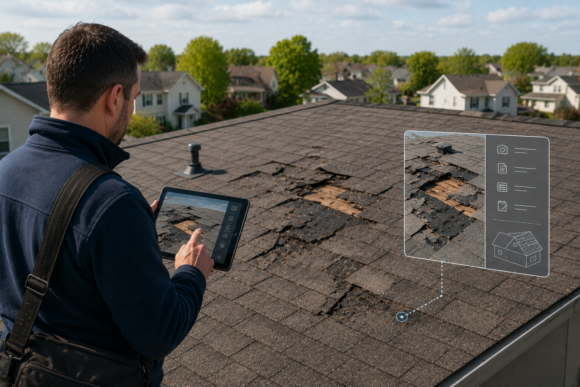
In property/casualty claims, the initial inspection does more than document damage. It establishes the foundation for how the claim will be evaluated, reserved and ultimately resolved. When that inspection is incomplete, rushed, or performed without sufficient expertise, the effects rarely remain isolated. Assumptions compound. Decisions drift. By the time issues surface, correction is often costly and disruptive.
This is not a new problem. What has changed is how consistently it appears and how deeply its causes are embedded in standard claims operations.
Across the industry, the field adjuster role is shifting. What was once a function grounded in judgment, experience and on-site decision-making is increasingly oriented around documentation and data capture. That shift is gradual, but its downstream effects are becoming more visible in reserve volatility, extended claim cycles and inconsistent outcomes.
The issue is not simply operational. It is structural. A gap has emerged between what is observed in the field and how claims decisions are made.


On-Site Judgment to Centralized Decision-Making
Historically, field adjusters played a central role in interpreting losses. They assessed causation, evaluated damage in context and applied policy language in real time. Their authority reflected a combination of training, experience and practical understanding of coverage.
In many organizations today, that model looks different.
The adjuster workforce is aging, and experienced professionals are leaving faster than they are replaced. At the same time, claims are becoming more complex. Coverage structures are more sophisticated, regulatory expectations are higher and catastrophe activity continues to increase.
Operational demands have driven change. Catastrophe response models allow for rapid scaling. Third-party resources provide flexibility. Technology enables centralized oversight and standardized workflows.
These developments improve efficiency. They also redefine the role of the field adjuster.
Related: Adapting Claim Investigations for AI-Driven Fraud
In many cases, field personnel are no longer expected to interpret losses. Their role is to document conditions. Coverage analysis, valuation decisions and settlement authority are often handled remotely. The result is a separation between the point of inspection and the point of decision.
Consequences of the Inspection Gap
That separation introduces risk, even when processes appear efficient.
Claims evaluation depends on context. The condition of a property before a loss, the sequence of events and subtle indicators of causation often do not translate fully through photographs or templated reports. These details are typically identified through experience and real-time observation.
When that context is missing, decisions are made on incomplete information. Outcomes may still be reasonable in individual cases, but consistency declines.
For risk managers, the impact is immediate. Variability in inspections leads to variability in scope. Inconsistent scoping drives reserve volatility. In turn, reserve volatility affects forecasting accuracy and total cost of risk.
Operational effects follow. Claims that require reinspection or reassessment take longer to resolve. Delays extend recovery timelines. Inconsistent evaluations increase the likelihood of disputes, particularly when similar losses produce different outcomes.
The industry has made significant investments in speed and efficiency. Less attention has been paid to how those gains affect consistency at the inspection stage.
Technology Cannot Close the Gap Alone
Claims technology has improved visibility and control. Digital platforms, analytics and AI-driven tools allow organizations to monitor performance and identify trends across large claim portfolios.
These tools, however, depend on the quality of the underlying data.
When inspections are inconsistent, the data generated from those inspections reflects that inconsistency. Analytical models can process the data, but they cannot correct for gaps in how it was captured. The output may appear precise while being based on uneven inputs.
AI is often positioned as a solution to variability. It can standardize workflows, flag anomalies and support decision-making. It cannot replace the judgment developed through field experience.
In practice, technology tends to reinforce existing conditions. Where inspection quality is strong, outcomes improve. Where it is inconsistent, variability becomes more difficult to detect and manage.
Coverage Awareness at the Point of Inspection
Another dimension of the inspection gap is the reduced connection between inspection and coverage analysis.
Experienced adjusters have traditionally approached inspections with policy language in mind. That perspective influenced what they documented, how they evaluated causation and which issues they escalated.
Related: Nine Claims Trends to Watch Through The Rest of 2026
In many modern workflows, that link has weakened. Field personnel may not have full visibility into policy terms or may not be expected to apply them. Coverage analysis is often handled separately by centralized teams.
This separation creates blind spots. If an inspection is not guided by coverage considerations, relevant details may not be captured. Once missed, those details are difficult to reconstruct.
For complex commercial claims, where specific provisions can materially affect outcomes, this gap becomes more significant.
A Talent Issue with Structural Effects
The industry’s talent shortage is often framed as a capacity issue. It is also a capability issue.
As experienced adjusters retire, organizations lose institutional knowledge. The ability to distinguish between similar types of damage, identify indicators of causation and connect physical observations to policy provisions develops over time. It is not easily replicated through abbreviated training or standardized processes.
New adjusters are frequently deployed quickly, particularly during catastrophe events, and are expected to perform under time pressure. Centralized oversight and structured workflows are intended to compensate for experience gaps.
In some cases, they do. In others, they introduce variability that becomes normalized.
The longer-term risk is not just inconsistency. It is reduced sensitivity to it.
Managing the Gap Before a Loss Occurs
If the initial inspection plays a central role in claim outcomes, the question for risk managers is how much control exists over that stage of the process.
Traditionally, claims handling has been treated as a post-loss function. That approach is evolving.
Organizations are increasingly incorporating claims strategy into pre-loss planning. This includes evaluating how inspections will be performed, who will perform them and how consistency will be maintained under surge conditions.
Adjuster continuity is one area receiving renewed attention. When adjusters are familiar with an organization’s operations, facilities and risk profile, they bring context that improves both inspection quality and alignment with coverage.
The broader issue remains. The first inspection continues to shape the outcome of the claim. What has changed is the degree to which that inspection is connected to expertise, context and decision-making authority.
Delgado is an insurance attorney at Merlin Law Group representing policyholders in complex insurance disputes. Based in the firm’s Florida office, he is licensed in Florida, Texas, New York, Washington, D.C., and the U.S. Virgin Islands, and works with local counsel across other states and the Caribbean. Email: jdelgado@merlinlawgroup.com.
Font is an insurance attorney at Merlin Law Group, representing policyholders in catastrophic and large-loss property insurance disputes. Based in the firm’s Florida office, he has experience in insurance claims, appraisals, and catastrophe loss adjustments, and routinely works with co-counsel across multiple states. Email: efont@merlinlawgroup.com.
Was this article valuable?
Here are more articles you may enjoy.
 First Atlantic Hurricane of 2026 to Threaten US Gulf Coast
  HSBC Executive Strikes Back in Court Fight Over Poaching Claims
  San Diego Sues AppLovin Over Explicit Ads Shown to Kids’ Devices
  UIM Minimum Limits. A Coverage That May Not Pay?
Want to stay up to date?
Get the latest insurance news
sent straight to your inbox.