
Former Red Lobster owner Thai Union Group Plc said the money-losing $20 all you-can-eat shrimp promotion that has become a focus of litigation arising from the restaurant chain’s bankruptcy wasn’t its idea, arguing that the company’s managers introduced it to counter falling traffic and rising costs.
Thai Union made the argument in a court filing seeking to dismiss a civil lawsuit filed by a trust representing creditors that lost money in Red Lobster’s 2024 Chapter 11 case. The chain emerged from bankruptcy last year and is now owned by an investment group led by Fortress Investment Group.
“This lawsuit is a cynical attempt by Red Lobster to blame one of its former owners and suppliers for the failures of Red Lobster’s own management decisions and business model,” Thai Union’s lawyers said in Tuesday’s filing.
Related: Endless Shrimp Deal Was Scheme to Squeeze Red Lobster, Suit Says
The creditor trust represents vendors, food distributors and other unsecured creditors that were owed about $295 million when Red Lobster entered bankruptcy. It accuses Thai Union of “self-dealing and exploitation of Red Lobster” and is seeking to unwind $32 million in transactions that it claims Thai Union and other entities forced the chain to enter into in 2023.
A lawyer for the trust declined to comment Wednesday. Spokespeople for Thai Union and Fortress also declined to comment, while Red Lobster representatives didn’t respond.
Thai Union, a major seafood supplier, has long disputed allegations tied to the “Ultimate Endless Shrimp” promotion. Tuesday’s filing offers the company’s most detailed defense against the claims since the trust sued in May.
As part of that defense, Thai Union cited a 2024 internal investigation undertaken by a law firm representing Red Lobster’s independent directors. The investigation concluded that there didn’t appear to be any viable legal claims against the former owner, according to court papers. The law firm’s report also said Red Lobster was concerned that raising prices after launching Endless Shrimp could lead customers to view the move as a “bait and switch” tactic, the filing said.
Red Lobster Restaurant Locations
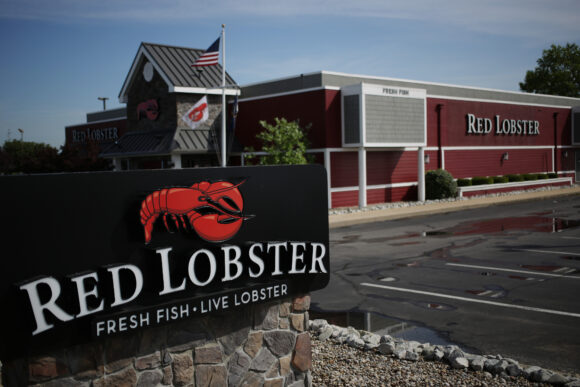
An American flag flies past Red Lobster signage displayed outside of a restaurant location in Clarksville, Indiana, U.S., on Monday, June 22, 2015. Red Lobster is a casual dining restaurant chain that is headquartered in Orlando, Florida. Photographer: Luke Sharrett/Bloomberg
All you-can-eat shrimp had previously succeeded in drawing customers into restaurants, Thai Union said, adding that Red Lobster’s former interim CEO thought $20 “was the ‘magic number.'” The same former Red Lobster executive also initiated a review of the chain’s shrimp suppliers, making the unilateral decision to suspend one supplier and determining another was too expensive, according to Thai Union.
The company also argued that Red Lobster was already under pressure from rising labor costs, a consumer shift away from casual dining and a heavy real estate burden after Covid-19-era lockdowns.
Before bankruptcy, Red Lobster leased 687 locations and spent $190.5 million on lease obligations in 2023 alone, with many of the leases priced above market rates, according to the filing. Guest traffic fell about 30% between 2019 and 2024.
Related: Red Lobster Landlord Sues Insurer to ‘Clawback’ $1.2M Fire Claim Payment
Thai Union made a $575 million minority investment in Red Lobster in 2016 and acquired the remaining equity in 2020 alongside other investors, according to court papers.
The company called it implausible that it would jeopardize that investment to generate about $33 million in additional shrimp purchases. To the extent its shrimp was more expensive, Thai Union said, that was likely because it was “the only supplier meeting Red Lobster’s criteria and had to supply unprecedented quantities of shrimp on short notice.”
The trust had alleged that Thai Union subsequently dispatched several representatives to Red Lobster’s headquarters in Orlando — one being Paul Kenny, a restaurant executive and Thai Union shareholder, who made clear to Red Lobster’s senior management that he, not Chief Executive Officer Kelli Valade, was in charge.
Thai Union said Tuesday that the only decisions the lawsuit criticizes were made by Kenny, not Thai Union. Moreover, Thai Union said the suit doesn’t claim the company did anything to enable Kenny’s decisions.
Red Lobster is now roughly two years into a turnaround effort under Chief Executive Officer Damola Adamolekun. It revived the shrimp promotion in April as a limited-time offer while the struggling chain looks to lure diners.
Top photo: An American flag flies past Red Lobster signage displayed outside of a restaurant location in Clarksville, Indiana, U.S., on Monday, June 22, 2015. Photographer: Luke Sharrett/Bloomberg.
Was this article valuable?
Here are more articles you may enjoy.
 Critical PHP Flaws Spur Global Patch Effort, Temporary Shutdowns
  Bank of England Considers Stress Testing AI’s Effect on the Financial Sector
  Burned by Fire, Malibu’s Million-Dollar Mansions Face a New Threat: El Niño
  Apple-OpenAI Judge Says He’s ‘Likely’ to Side With iPhone Maker
Want to stay up to date?
Get the latest insurance news
sent straight to your inbox.