
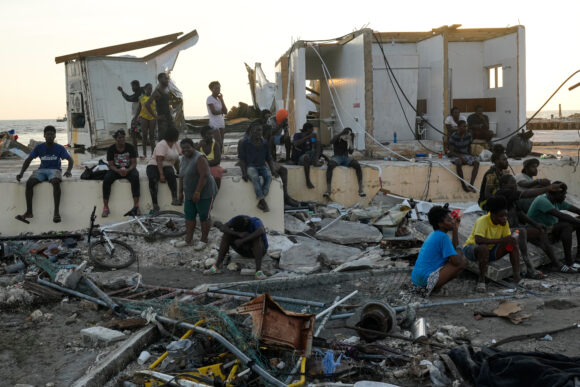
For one claims professional who is working in Jamaica, it is clear that the scale of the damage left in the wake of Hurricane Melissa will have a long-lasting, and far-reaching impact for businesses and people.
But the biggest concern for Roland Riviere, who has been in the claims field for more than four decades, is that the island-nation’s tourism business was hit hard.
Tourism is a major part of the country’s economy. The Jamaica Ministry of Tourism reports that the country earned $4.3 billion from the industry in 2024, more than 10% of its GDP, with roughly 4.3 million annual visitors. The sector employs 175,000 people and creates 354,000 indirect jobs.
“It’s the obvious hotel resorts have been impacted,” said Riviere, senior executive general adjuster in the Latin America and Caribbean hub office of Sedgwick.
Related: Lack of Hurricanes Is Leading to Lack of Experience for Adjusters
He was speaking recently to Claims Journal on a shaky connection from Kingston, where internet, power and other services are still sporadic weeks after the storm. He is part of a team of more than two dozen adjusters, building consultants, engineers and others there surveying damage and helping to process claims.
The team is getting increasingly more access to damaged properties, and what he’s seeing is devastation. He described some of properties he has surveyed in the affected areas as being “flattened.”
“A lot of homes are totally destroyed,” he said. “We have the concept of constructive total loss—when something costs more to repair than what it’s worth—these are actual total losses; there’s nothing left to that you could repair. In the areas where it hit, it’s prevalent.”
Riviere is seeing large commercial properties that suffered losses, including distribution centers, myriad stand-alone retail stores and malls spanning from small strip centers to large retail outlets.
He is also seeing the impact of losing those businesses on people who need goods and services, as well as people who work in the places that were damaged or destroyed.
“All these things have their own impact on the economy, because everything is slowed down,” he said.
Category 5
The Category 5 hurricane made landfall in Jamaica on Oct. 28, the strongest recorded storm to directly hit the country, and the first major hurricane to hit Jamaica since 1988. The catastrophe affected millions across Cuba, Haiti, Jamaica, and the Dominican Republic, resulting in 76 deaths and displacing more than 770,000 people.
Melissa caused catastrophic damage to Jamaica, particularly in the western and southern coastal regions. The eyewall hit the south coast with winds estimated at roughly 125 mph, ripping roofs off buildings, breaking countless power lines and decimating crops and infrastructure. Most (70%-plus) electricity customers in Jamaica were left without power, and many areas remained without power for an extended time.
Insured losses from the storm’s impact on Jamaica are expected to range between $2.2 billion and $4.2 billion, according to estimates from data analytics firm Verisk. Catastrophe modeler KCC estimates privately insured losses from Melissa will reach $2.4 billion. That estimate includes insured damages to residential, commercial and industrial properties in Jamaica and Cuba.
Jamaica’s $150 million cat bond was triggered by the “black swan” event. According to a Bloomberg report, in addition to the $150 million it will get from its cat bond, it can tap $300 million in contingent credit from the Inter-American Development Bank and draw a $92 million payout from a parametric insurance program.
Gallagher Re has said it expects Melissa to be a billion-dollar-plus event for reinsurers.
“The uncertainty around the potential industry impact and limited cat model performance in the Caribbean makes this a challenging event to estimate without seeing some hard data,” said Steve Bowen, chief science officer at Gallagher Re. “Our current expectation remains low single digit billion insured loss, including payouts from the Jamaican cat bond and parametric TC policy from CCRIF. The economic loss will be much higher, and combined with impacts outside of Jamaica, is expected to approach $10 billion.”
Tourism
Riviere worries that the travel sector could be hit with a double whammy, if the same trend follows what happened to the leisure and hospitality sector after the passage of Hurricane Beryl in 2024, when workers left hard-hit hotels and resorts to find jobs elsewhere and they did not return.
“So, we have then had a bit of a shortfall of labor force in the industry because these workers… found something that might have been better hours or better pay,” he said. “It’s very difficult to tell, but once they were restored after Hurricane Beryl last year, one of the comments from hotels and resorts was that some of their employees did not come back.”
Retaining employees and reopening as soon as possible to serve tourists in time for peak visitor season are why resorts are pressing to get back up and running.
“It’s fair to say a lot of resorts were hit, a lot of travel was affected, but a lot of travel businesses are looking in to be in recovery mode and filing claims. And you’d be shocked that some hotels are starting to reopen, some of the ones that were less damaged are starting to reopen away from the center of the damage…the reaction we’ve seen is quite clear, that they’ll do whatever it takes to reopen as soon as soon as possible,” Riviere said.
Personal Lines
One trend that has somewhat surprised Riviere has been the claims coming in from personal lines.
“We are seeing that is very, very slow to come in,” Riviere said.
It’s expected that the first few days after a disaster for personal lines claims to flow in slowly as people deal with more immediate problems, like putting a roof over their heads and ensuring their families are safe. A week or two after disaster is when homeowner claims start to steadily flow in, he said.
“And we’re not seeing that,” Riviere said. “It’s a bit of a surprise, because we’re ready for homeowner claims, and they’re very slow to come in.”
A low volume of claims from areas like the South Shore, where insurance penetration is lower, makes sense—but not so much in areas where insurers have big books of homeowners insurance business.
Related: Five Reasons Why The US Escaped A Hurricane Landfall So Far
“In Montego Bay, and areas where there are big centers of population, we do see where our insurance companies tell us that they do have a book of homeowners business, but those claims are still coming in slowly,” Riviere said.
He surmises that what may be keeping many homeowners from filing claims could just be the difficulty communicating.
“It’s still very difficult to get to cell or internet, etc…because a lot of cell towers are down and a lot of communications lines are down,” Riviere said. “In fact, our teams are all operating on Starlink.”
The good news is that communications and services are coming online—slowly. That may lead to more claims being filed, and it will enable experts like Riviere to get a clearer picture of the losses. He declined to provide any loss estimates at this time.
“Every day, the North Shore gets a little bit better,” Riviere said. “(The other day) I was in Montego Bay, and this is one of the things that—it’s kind of almost humorous, which it shouldn’t be—but we celebrate the fact that in Montego Bay there was a traffic light working. So, it means it’s the return of the utility power. We’re seeing those things ameliorate every day and we are expecting that once these things get resolved—or they are at least temporarily resolved—we are expecting to see some more activity on the domestic homeowner book of business.”
Because Jamaica is an island nation, rebuilding is a slower process than in the U.S. or Europe, for example, where a neighboring state that didn’t sustain damage can easily contribute resources and aid.
“You cannot have that on the island,” Riviere said. “It’s impossible to achieve in the short term and difficult to achieve even midterm. It takes a while before they can get physical help from others.”
Top photo: People gather among debris near a bridge in Black River, Jamaica, Oct. 30, 2025, in the aftermath of Hurricane Melissa. (AP Photo/Matias Delacroix, File).
Was this article valuable?
Here are more articles you may enjoy.
 Burned by Fire, Malibu’s Million-Dollar Mansions Face a New Threat: El Niño
  Hackers Tricked Asos Employee to Steal Work Account Login
  First Atlantic Hurricane of 2026 to Threaten US Gulf Coast
  Tesla Launches Roadster at SpaceX Site in Latest Merger Hint
Want to stay up to date?
Get the latest insurance news
sent straight to your inbox.