
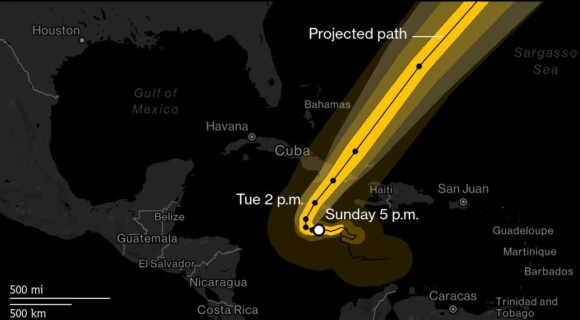
Hurricane Melissa plowed toward Jamaica as a powerful Category 5 storm, threatening to bring widespread destruction to the island.
Melissa’s top winds reached 160 miles (257 kilometers) per hour, the U.S. National Hurricane Center said in an advisory at 8 a.m. local time. Destructive winds, storm surge and catastrophic flooding are expected to worsen Monday before Melissa makes landfall overnight. If it maintains its strength, Melissa would be the first confirmed Category 5 storm — the highest on the Saffir-Simpson scale – to hit Jamaica.
Melissa, currently about 135 miles southwest of Kingston, is forecast to dump as much as 30 inches of rain across parts of Jamaica, and the hurricane center has warned that the torrent could trigger landslides. More than 800 shelters have been opened across the island and local authorities have staged heavy equipment to clear debris from roadways.
Jamaica’s losses will range between $5 billion to $16 billion, depending on the exact track across the island, said Chuck Watson, a disaster modeler with Enki Research. There will likely be another $5 billion of losses in Cuba. From there, the storm is forecast to sweep through the southern Bahamas and possibly approach Bermuda by Thursday. Melissa has killed at least three people in Haiti and one person in the Dominican Republic.
“All scenarios except some kind of divine intervention look utterly devastating at this point,” Watson said.
While the data is spotty in places, there is no record of a storm this strong ever hitting Jamaica since 1851, said Phil Klotzbach, a hurricane researcher at Colorado State University. Before Melissa, the most powerful storm to hit the island was Gilbert in 1988, as a Category 4 with winds of about 132 mph.
In the Atlantic this year, Hurricanes Erin and Humberto also reached Category 5, though neither threatened land. Gabrielle hit Category 4, which means four storms have become major hurricanes across the Atlantic in 2025, compared with an average of three by the end of October. The six-month season officially ends on November 30, but storms can take shape in every month of the year.
Klotzbach said in an X post that the only other year more than two Category 5 hurricanes formed in the Atlantic was 2005, which produced four — including Katrina, which devastated New Orleans.
Explainer: How Climate Change Is Fueling Stronger Hurricanes
A hurricane warning has been issued for four provinces in Cuba, where Melissa is forecast to hit after devastating Jamaica. Companies have evacuated workers and the U.S. Navy pulled non-essential personnel out of its base on Guantanamo Bay, Cuba.
Melissa’s slow crawl across the region makes flooding worse because its heaviest rains will linger for days. In a warmer world due to climate change, the atmosphere holds more water, worsening heavy rains from tropical systems.
Melissa has the force to flatten homes, snap trees and touch off power outages that can last for weeks or months. It can also push a wall of water up to 13 feet into the coastline where it comes ashore. About half of all hurricane deaths come from drowning.
A hurricane watch is in effect for southeastern and central Bahamas and the Turks and Caicos Islands. Flooding rains are also forecast across Haiti and the Dominican Republic.
After the storm rips through Jamaica and Cuba, it’s forecast to move into the Bahamas. There is a chance it may menace Bermuda later in the week.
Was this article valuable?
Here are more articles you may enjoy.
 Prime London Homes Are Increasingly on Frontlines of Extreme Weather
  Hurricane Isaias Reaches Category 3 as It Nears Florida, Alabama
  Warren, Hawley Press Insurers Over Closed, Unpaid Claims
  UIM Minimum Limits. A Coverage That May Not Pay?
Want to stay up to date?
Get the latest insurance news
sent straight to your inbox.