
Volkswagen AG, Stellantis NV and Renault SA are joining forces to push for regulation favoring automaking in Europe to help them compete with a surge of affordable cars from China.
The mass-market manufacturers, which make up 60% of vehicle output in the European Union, on Friday sent proposals to EU policymakers, calling for a clear and timely framework to boost local sourcing of components, development and assembly. The document recommends a range of tweaks to Brussels’ existing plans to better protect one of its key industries.
Rewarding local content will help carmakers facing an “unprecedented challenge to their competitiveness due to significant technology gaps in strategic areas, intense global competitive pressure and persistently high energy, manufacturing and regulatory costs,” the three automakers said. Friday’s statement marks Renault teaming up with the region’s top two carmakers for the first time to sharpen the policy.
Related: BASF Warns Iran War Could Trigger Supply Chain Disruption for Carmakers
Europe’s automakers are struggling with the volatile transition to electric cars and sluggish demand that’s leaving many factories operating far below optimum levels. The changeover to battery power has also opened the door to competitors, with China’s BYD Co. and SAIC Motor Corp.’s MG brand rapidly taking market share with attractively priced models such as the BYD Atto 3 compact sport utility vehicle.
Locked in a brutal price war at home, China’s burgeoning car industry is seeking fresh outlets after years of generous incentives. Manufacturers are churning out new models at rapid speeds, leapfrogging Western competitors, to attract buyers with fresh features and gadgets. Still, the world’s biggest car market is in reverse with sales down by a fifth so far this year.
Some of Europe’s manufacturers are calling for deeper measures to ease the transition for an industry that’s already started shedding jobs. On Friday, they said the ‘Made in Europe’ proposals in the bloc’s Industrial Accelerator Act, outlined late last year, should complement regulation on CO2 reduction.
Related: Stellantis, Wayve Target 2028 Driver-Assist Launch
They recommend easing the framework to require 70% of EU-made vehicles to contain at least 70% of the value of work and components from member state countries as well as Norway, Iceland and Liechtenstein. The benefit of hitting EU targets is set to include so-called “super credits” for small EVs built in Europe that count toward meeting tightening CO2 fleet thresholds.
Renault, VW and Stellantis said they want future super credits to be applicable to all EVs made inside the bloc. They also want a broader scope of what counts as local content to include research and development efforts as well as vehicle assembly.
The EU’s plans, part of a broad suite of policy measures to strengthen industrial competitiveness, are working their way through the legislative process with a draft act published by the European Commission in March.
Geographical Drawbacks
Non-EU carmakers like Toyota Motor Corp., Nissan Motor Corp. and Jaguar Land Rover are concerned the plans will exclude components manufactured in the UK, Japan and Turkey. Toyota has major production hubs in the UK and Turkey, while Nissan operates the UK’s biggest car plant in Sunderland.
Earlier this week, Toyota’s head of Europe, Yoshihiro Nakata called for an “inclusive approach with trusted partners” that would treat the Japanese carmaker as “equivalent.” He also warned of “severe” consequences for the commercial activities with investment in Europe to suffer.
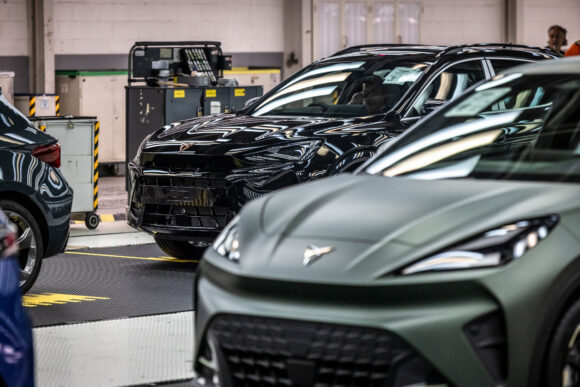
Top photo: Finished Cupra electric vehicles in Martorell, Spain. Bloomberg.
Was this article valuable?
Here are more articles you may enjoy.
 Apple-OpenAI Judge Says He’s ‘Likely’ to Side With iPhone Maker
  Psychological Reactance: The Hidden Bias in Claims Negotiation
  Home Insurance Tops Property Taxes in Squeeze for US Households
  Bank of England Considers Stress Testing AI’s Effect on the Financial Sector
Want to stay up to date?
Get the latest insurance news
sent straight to your inbox.