
Uber will invest up to $1.25 billion in electric vehicle maker Rivian as part of a deal in which the ride-hailing firm will start deploying 10,000 fully autonomous R2 SUVs as robotaxis from 2028, the companies said on Thursday.
San Francisco-based Uber will make an initial investment of $300 million, and will fund the remaining amount through 2031, subject to Rivian meeting certain autonomous milestones, the companies said.
Related: Lucid Unveils Steering Wheel-Free Robotaxi Concept, Taking Aim at Tesla’s Cybercab
Uber’s investment is seen as crucial for Rivian, providing both much-needed capital and a high-volume commercial partner.
Rivian said it no longer expects to achieve adjusted core profit in 2027 as it ramps up research and development spending to accelerate its autonomous driving roadmap.
“We believe this was widely expected,” said BNP Paribas analyst James Picariello. “We do still expect Rivian to achieve breakeven EBITDA in 2028, with positive free cash flow in 2030. We believe Uber’s initial investment will cover the additional R&D spend.”
Rivian’s shares pared gains after gaining nearly 12%. The stock was last up about 1% in afternoon trading.
Interest in driverless taxis has surged in recent months after years of missed promises, with artificial intelligence and tech partnerships offering hopes of solving complex traffic scenarios faster and mitigating high costs.
Related: Nuro’s Self-Driving Car Tech Hits Tokyo Streets in First International Deployment
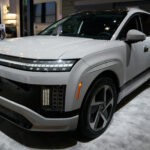
While Rivian, known for its high-end R1S SUVs and R1T pickup trucks, has not launched a robotaxi yet, it unveiled its first custom computer chip for self-driving in December. The company is also gearing up to roll out its smaller, more affordable R2 SUVs this quarter.
Meanwhile, Alphabet’s Waymo, which runs about 2,500 robotaxis in several U.S. cities, has accelerated its rollouts, while Tesla has launched a small robotaxi service in Austin, Texas, with CEO Elon Musk promising rapid expansion this year.
R2 robotaxis will be available exclusively on Uber’s platform, starting with San Francisco and Miami, the companies said, adding that Uber has the option to buy up to 40,000 more beginning in 2030.
“Should all milestones be achieved, the companies will have deployed thousands of unsupervised Rivian R2 robotaxis across 25 cities in the U.S., Canada, and Europe by the end of 2031,” they said.
Uber is positioning itself as a marketplace for multiple robotaxi operators, and has partnered across much of the autonomous vehicle industry, including with Waymo, Baidu 9888.HK and Lucid.
It is also working with Nvidia on autonomous driving, leveraging the chip designer’s AI and simulation platforms to support the development and scaling of robotaxi systems.
(Reporting by Roy in San Francisco and Sriram in Bengaluru; Editing by Leroy Leo and Alan Barona)
Was this article valuable?
Here are more articles you may enjoy.
 Report: Property Claims Face Delays, Are Growing More Complex
  Agentic Intelligence for Claims Dominates New Tech Launches
  Anxiety Over Gas Prices Points to ‘Looming EV Comeback’ in US
  Goldman Sachs Ensnared in EY Data Breach Earlier This Year
Want to stay up to date?
Get the latest insurance news
sent straight to your inbox.