
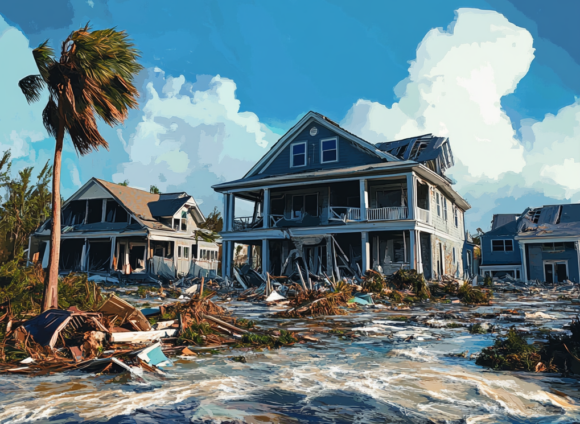
There has been a lot of recent conversation throughout the insurance industry around resiliency fortification efforts and how to help facilitate them.
For claims leaders, this is a particularly important conversation because the level of resiliency of the structures in an insurance portfolio is a significant indicator of future claims frequency, especially in weather-prone areas.
When Can Building Fortification Make A Difference?
Weather-prone areas with high natural disaster risk profiles are the obvious place to focus on resilience strategies to prevent future losses.
In 2025 alone, there were 23 weather and climate disasters in the U.S. with at least $1 billion in damages. There are all kinds of weather risks: tornadoes and hailstorms in the middle of the country, tropical cyclone activity along the Gulf Coast and up through the Mid Atlantic Coast, and flooding and wildfires out West, to name a few. In fact, there isn’t any place in the U.S. that doesn’t have some kind of natural disaster risk at some point in the year, and we have historically seen a significant number of claims following these events.
Perhaps the biggest recent driver of conversation around building fortification and how it can make a difference in the face of a natural disaster are the Southern California wildfires of January 2025.
A total of 16,246 structures were destroyed in both the Eaton and Palisades fires, and one year on from this tragedy, the L.A. area is rebuilding. Now, the question of where and how to leverage resilient materials and methodologies is taking a front row seat. Structures like the “miracle mansion of Malibu,” which stood as those around it burned to the ground, offer a clear picture of how fire-resistant architecture and defensible open space can leave a building intact, sparking local interest in options for resilient rebuilding.
The need to rebuild has created an inflection point for these conversations to take place in California, but the region is not unique in the construct of its housing stock. We have many older structures across the U.S. that weren’t built with resiliency in mind, and there is currently no coordinated process for bringing all that inventory up to a higher standard.
Waiting for disaster to strike is not a viable solution. According to the U.S. Chamber of Commerce, every dollar not spent on resilience before a disaster can cost communities up to $33 in lost future economic activity. There needs to be an orchestrated effort across the insurance industry and government, coming together to solve this challenge and then bring that resolution to the front.
What Is Holding Us Back?
Despite the clear benefits of building fortification, as California residents are now discovering, one of the biggest challenges lies in determining who will foot the bill.
Resilient solutions come at a higher price, and while some homeowners may prioritize the peace of mind these products and materials provide, many are unwilling or unable to make the investment. This may be a shortsighted choice; the National Institute of Building Sciences reports that adopting the latest building code saves $11 per $1 invested, and above-code design could save $4 per $1/cost. In some cases, we’re now seeing the insurance industry responding, motivated by the potential to reduce future claims and increase customer satisfaction. In other instances, government entities are providing grant money to protect areas.
Another challenge is awareness. Even where efforts are underway to fund resiliency programs, getting the word out about these programs and how to access them is not easy.
In some parts of the country, groups have received government funding, which is pooled and offered to property owners for the express purpose of upgrading their structures to be more resilient. But the methodologies for how this happens are not consistent, which presents a communications challenge. Some require the property owner to get a quote, and the grant money gets paid directly for the repairs. With others, the homeowner must do the work and then submit their application for reimbursement. Irrespective of the mechanics, if people are not aware of these programs, they are not going to take advantage of them.
One factor that is helping to accelerate a push toward building fortification is building codes, which do get changed over time. Most insurance carriers offer code upgrade coverage already, so a change in building code is one good option for driving increased resiliency. This varies by company and by policy. Some insurers limit it to a dollar or percentage amount, others may not offer it. And of course, some people may choose not to buy the endorsement. This is a place where additional education would be helpful.
How Can The Insurance Industry Can Drive Resiliency?
The insurance industry has both motivation and opportunity to crack the code on supporting resiliency efforts. We see a significant number of claims throughout the year that offer a chance to enhance structure resiliency. The process of rebuilding a property offers an ideal moment to put it back with more resilient materials, and we are in a unique position to connect the dots for property owners about the options that are available to them—both in terms of the scope of the upgrades that can be done and how to cover the associated expenses.
Many need education about the resiliency funding that they could be accessing; others may need guidance to help them understand their code upgrade coverage and determine what falls under policy guidelines. Even simply letting property owners know that state or county funds may be available to help upgrade a roof they are already replacing is a valuable communication touchpoint and can build goodwill by showing that we’re helping them access resources they might not otherwise know about.
The insurance industry is becoming more active in the conversation around these sustainability and resiliency efforts. It is in carriers’ best interest to do so; foremost because more resilient structures will mitigate money spent on future insurance claims, but also because it is the right thing to do for the individuals and communities that they serve.
The time is now in the U.S. for us to get aligned around solutions that can be win/wins for property owners and for the insurance industry – before the inevitable next natural disasters occur.
Malcolm is president, U.S. network solutions at Crawford & Company. He has been a claims executive in various roles for 25 years. He has an extensive property insurance background with expertise in commercial and personal lines as well as catastrophe.
Was this article valuable?
Here are more articles you may enjoy.
 Hackers Tricked Asos Employee to Steal Work Account Login
  Will California’s New Smoke Claims Law Create a Recovery Bottleneck?
  Prime London Homes Are Increasingly on Frontlines of Extreme Weather
  UIM Minimum Limits. A Coverage That May Not Pay?
Want to stay up to date?
Get the latest insurance news
sent straight to your inbox.