
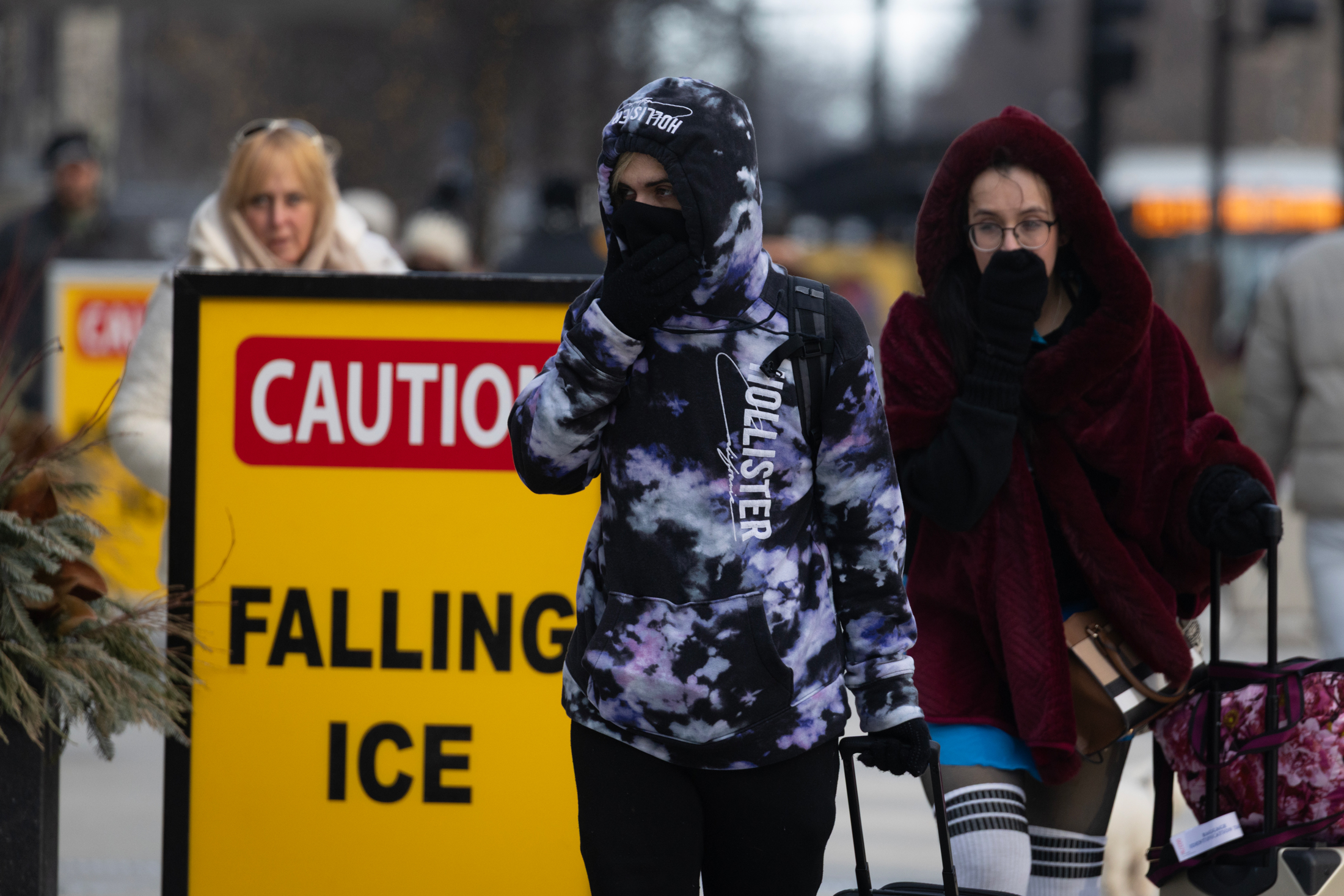
More than 100 million people are facing frigid conditions across the eastern and central U.S., including the entire state of Texas, as an arctic blast threatens to break low-temperature records.
Extreme cold has pushed deep into the central U.S. all the way to the Gulf Coast and is spreading to the East Coast and Mid-Atlantic, the National Weather Service said. St. Louis will drop to 3F (minus 16C) overnight, while Dallas is poised to fall to 14F as the chill reaches its zenith before slowly moderating through the rest of the week.
Across the US, more than 200 daily records for cold temperatures may be tied or broken through Friday, the U.S. Weather Prediction Center said. Meanwhile, extreme cold warnings are also in place across central Canada, according to Environment and Climate Change Canada.
Frigid Temperatures
“It’s pretty much near the peak of this arctic blast across the central U.S. if you look at the magnitude and the expanse,” said Andrew Orrison, a forecaster with the Weather Prediction Center. “We have 100 million people under an extreme cold warning or cold weather advisory.”
The Electric Reliability Council of Texas, the state’s grid operator, said electricity demand will jump in the coming days but it expects to be able to meet the spike in consumption. Regulators and lawmakers have moved to bolster the state’s power system after the grid collapsed during a series of winter storms in 2021, killing hundreds of people as homes and businesses were left in the dark.
PJM Interconnection LLC, which oversees the grid from Chicago to the East Coast, issued a cold weather alert, asking power-plant operators to defer maintenance and testing if possible.
While the deep freeze grips the central U.S., snow is expected to fall from southeastern Missouri to Virginia and North Carolina. As much as 6 inches (15 centimeters) to 10 inches may drop across parts of the region before the storm pulls into the Atlantic.
By the end of the week, milder air will sweep in off the Pacific and spread east across the U.S., Orrison said. By the beginning of next week, temperatures will be above normal in many places and considerably drier, which will help recovery efforts in flood-stricken Kentucky.
Top photo: People face freezing conditions on Michigan Avenue, Chicago. Photographer: Scott Olson/Getty Images.
Was this article valuable?
Here are more articles you may enjoy.
 Anxiety Over Gas Prices Points to ‘Looming EV Comeback’ in US
  Slips, Trips And Falls: Why It’s Important to Get Ahead of An Incident
  Google Accused of Overcharging 20 Million Consumers in UK Class Action
  Google Faces $3.2 Billion Damage Claims on Ad-Tech Monopoly
Want to stay up to date?
Get the latest insurance news
sent straight to your inbox.