
Fraud referral rates declined across several major lines, a new report shows.
Carpe’s 2026 Online Fraud Insights Report examines potentially fraudulent evidence identified through the company’s monitoring of open injury claims from 2024 to 2025. Despite the drop in fraud referrals, the modeled value of contradictory alerts rose from $230.6 million in 2024 to $263.8 million in 2025.
Carpe, which says the figure is an estimate based on carrier-reported outcomes and reserve-impact assumptions, said that data suggests that as the frequency of fraud may be decreasing, the severity and cost of those claims continue to drive substantial losses.
Referral rates declined from 8.9% to 7.2% for disability claims, from 6.9% to 6.2% for workers’ compensation and from 5.7% to 5.3% for auto claims. Disability continued to have the highest referral rate of the three lines. Auto accounted for 60.9% of all alerts, followed by workers’ comp at 26.8%. General liability accounted for 5.8% and disability for 1.3%.
The report also shows notable differences in the types of evidence generating alerts by line of business. Association with a business accounted for 42.7% of workers’ comp flags, more than twice any other category. Lifestyle activity accounted for 28.6% of auto alerts, followed by travel at 24.7% and physical activity at 24.6%. More than one third (35.7%) of referrals involving contradictory evidence surfaced within the first two months after a reported loss. Nearly two-thirds surfaced later, with referrals recorded as far as 24 months after a loss, the report shows.
Overall, 85.6% of evidence came from social media and 14.4% from non-social sources such as court records, booking records, local news and public databases. Facebook continued to be the largest source of social media evidence, accounting for 60.5% of contradictory flags. Instagram accounted for 13.8%, followed by LinkedIn at 7.8% and TikTok at 3.2%.
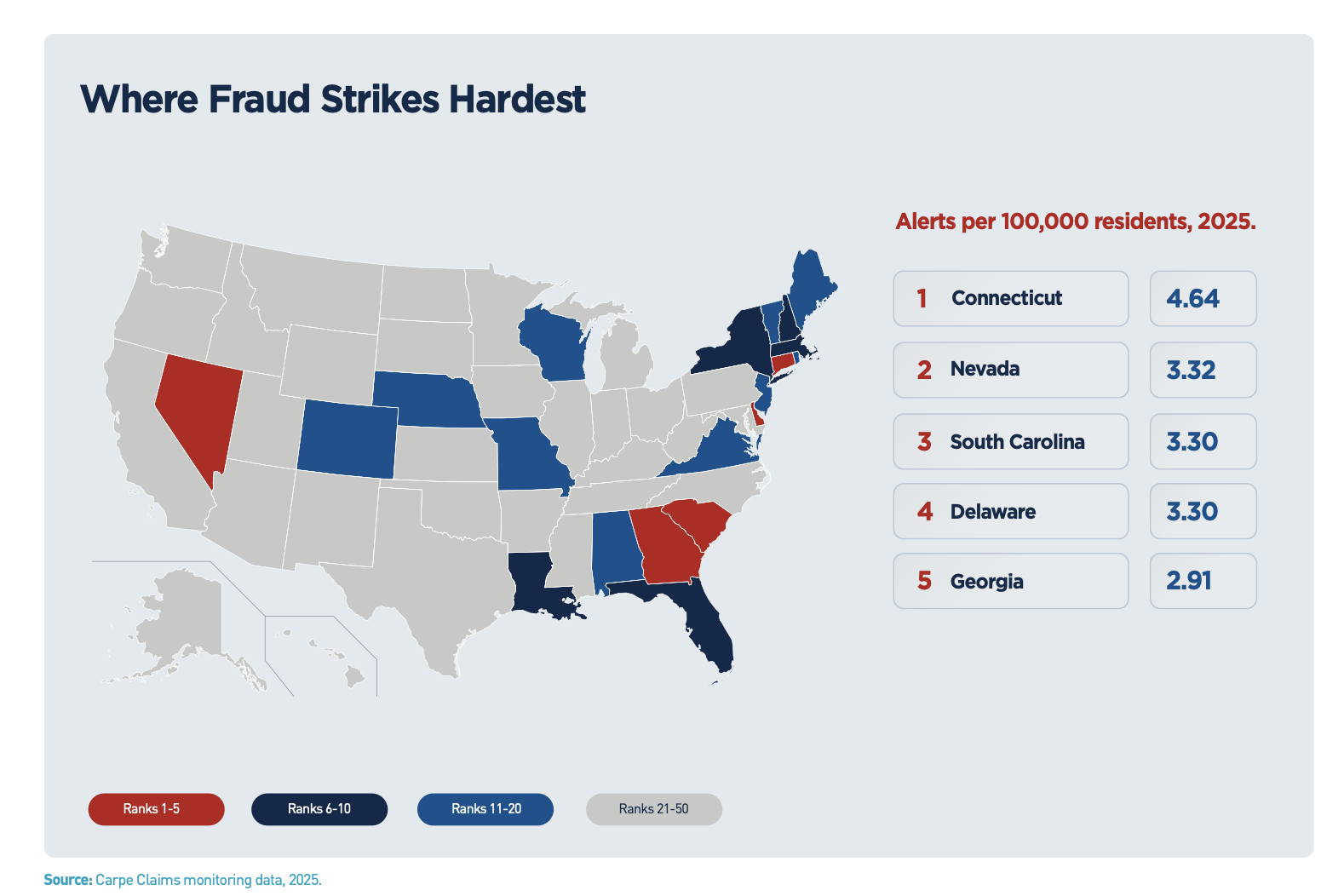
Connecticut had the highest rate of alerts per 100,000 residents at 4.64, followed by Nevada at 3.32, South Carolina and Delaware at 3.30 each, and Georgia at 2.91. California and Texas did not rank among the top 20 after adjusting for population. Las Vegas ranked first among metropolitan areas for alert concentration for a second consecutive year, followed by Los Angeles, San Antonio, Houston and Jacksonville.
Carpe cautions that the findings reflect claims assessed by the company and may not represent the broader U.S. claims population. The company also says alert shares should not be interpreted as fraud rates because the number and mix of claims assessed differ among segments.
Was this article valuable?
Here are more articles you may enjoy.
 Slips, Trips And Falls: Why It’s Important to Get Ahead of An Incident
  Prime London Homes Are Increasingly on Frontlines of Extreme Weather
  GM Loses Ground to Toyota as High Prices Reshape US Market
  Cyber Worker Allegedly Moonlighted as ShinyHunters Hacker
Want to stay up to date?
Get the latest insurance news
sent straight to your inbox.