
Alphabet Inc.’s Google LLC lost its bid Friday to escape a court case dangling the specter of legal liability for false statements made by an artificial intelligence chatbot.
A Delaware Superior Court judge let the conservative activist Robby Starbuck move forward with claims the tech giant’s Bard AI product — a predecessor of its current Gemini model — defamed him. The ruling could leave Google on the hook for Bard results that allegedly spread false sexual assault accusations, incorrectly linked Starbuck to the “notorious white supremacist” Richard Spencer, and offered arguments in favor of his execution.
Judge Meghan A. Adams acknowledged that the dispute opened “a new frontier for defamation law, in which artificial intelligence tools are allegedly employed to effectuate the defamatory ends of their makers.” But while the case may ultimately “force the court to take a deep dive into those novel issues,” the initial stages hinge on ordinary defamation precedents, Adams said.
The 36-page decision is the latest — though certainly not the last — to address the unprecedented ramifications of the unruly technology that in just a few years has reshaped law, commerce, culture, the workplace, and the basic frameworks defining the ways people interact.
Judges, legislators, business leaders, and policymakers are grappling every day with the fallout of the AI revolution. Friday’s ruling came less than two weeks after Delaware officials unveiled a plan to create a standalone legal structure, the AIC, that would confer corporate personhood on autonomously run firms.
Although Adams punted on first-of-their-kind issues raised by the litigation, she identified some of them, including Starbuck’s claim that Google deliberately engineered bias against him into its AI model — an allegation he said he got from the chatbot itself.
It would be premature to “discount the possibility, on a motion to dismiss, that Google AI, an artificial intelligence tool whose exact capabilities is not yet universally understood, can review and understand its own programming,” the judge said. “Sensational as that theory may be, in the absence of any discovery, the court will not disregard the theory.”
‘Radioactive Lies’
Starbuck — an anti-DEI crusader who has run successful social media campaigns targeting companies including Walmart Inc. and Harley-Davidson Inc. — sued Google last year, six months after bringing a similar case over a Meta Platforms Inc. chatbot that falsely stated he’d participated in the Jan. 6 attack on the US Capitol. Starbuck later dropped the Meta case.
His suit against Google, filed in October, said the platform was spreading “radioactive lies,” portraying him as “a child rapist, serial sexual abuser convicted of assault,” and a perpetrator of white-collar and campaign finance crimes — “in short, a monster.”
Delaware, corporate home to two-thirds of the Fortune 500, has become a go-to venue for politically charged defamation cases in recent years, including a wave of litigation over President Donald Trump’s false claim that the 2020 election was rigged against him.
California Gov. Gavin Newsom (D) won a decision in April letting his $787 million lawsuit against Fox News move forward in the same court, while French President Emmanuel Macron is suing right-wing podcaster Candace Owens there over her alleged “relentless and unjustified smear campaign” against his wife.
Starbuck is represented by Shaw Keller LLP, Baughman Law, and Dhillon Law Group Inc. Google is represented by Wilson Sonsini Goodrich & Rosati PC.
The case is Starbuck v. Google LLC, Del. Super. Ct., No. N25-C-10-211, 7/24/26
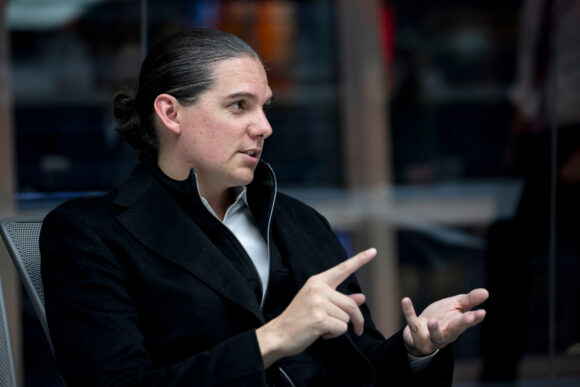
Photo: Conservative influencer Robby Starbuck speaks during an interview in New York, US, on Wednesday, March 5, 2025. The US Department of Justice signaled its intent to use criminal investigations to root out DEI practices in the private sector.
Was this article valuable?
Here are more articles you may enjoy.
 First Atlantic Hurricane of 2026 to Threaten US Gulf Coast
  TikTok Accused by NY of Running Secret Safety Tests on Teens
  Apple, OpenAI Head to Court in High-Stakes AI Trade Secret Fight
  Tesla Launches Roadster at SpaceX Site in Latest Merger Hint
Want to stay up to date?
Get the latest insurance news
sent straight to your inbox.