
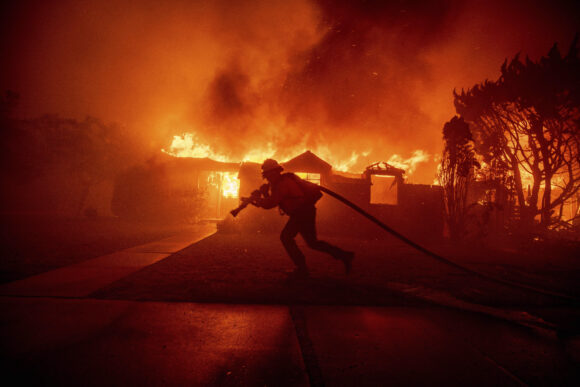
What’s being referred to as a super El Niño is now looking more than likely, and it brings with it increased wildfire risk in the West, drought and a possible “mini-Dust Bowl” in parts of the Great Plains, the potential of flooding in the South, and strong storms in the Pacific.
Now, “extreme wildfire” risk is threatening parts of Utah and the Western U.S. starting Friday, a new AccuWeather report shows.
The risk, expected to last into the weekend, comes as a below-average snow season across much of the region resulted in worsening drought conditions.
“Conditions are expected to turn dry and very windy late this week, posing extreme risk for new fire development and erratic behavior in active fires,” AccuWeather Meteorologist Brandon Buckingham stated in an update. “Multiple days of strong winds are expected this weekend into next week, which could prolong firefighting efforts and sustain dangerous, unpredictable wildfire conditions.”
AccuWeather climate forecasters now say there’s a 70% we’ll have a super El Niño, and they say that dry conditions in the Plains persisted for years afterward following previous events of this magnitude.
A super El Niño may already be helping to fuel severe heatwaves in Europe, with parts of France experiencing temperatures above 104°F. France had its hottest day ever on Wednesday.
In the U.S. several states are experiencing “extreme drought” conditions — compared to virtually no drought in those regions a year ago, according to the U.S Drought Monitor. Those states include Colorado, Nebraska, Oklahoma and Wyoming.
If the long-term drought is as bad as it could be, it raises the possibility of a ‘mini-Dust Bowl,” stressing crop yields that could last months or years ahead, impacting food production, food prices and water supplies, according to a recent warning from AccuWeather.
The U.S. West and Gulf Coast are set to be extremely hot in the summer while the rest of the nation may see cool days due in part to El Niño. The U.S. Climate Prediction Center forecasts the western and southern U.S. to be hot at least through July 10.
Tory Farney, vice president of Verisk Weather Solutions, is focused on the risk of wildfires, especially in the Northwest and Northern California and into portions the Great Basin and Four Corners, where the drought is worsening.
“On the increased risk side of things, certainly wildfire is one which we would look at there should be some increased likelihood,” Farney said. “It’s already been a pretty active wildfire year, and as we look at how conditions typically form under El Niño, we would expect to see drought conditions and warmer-than-average temperatures in the northwestern corner of the country and that’s exactly an area that’s already struggling with drought conditions.”
He’s also keeping an eye on the opposite side of country, which will likely experience wetter conditions across the South, leading to the increased potential of flooding.
Farney cautioned that not every El Niño is exactly the same, but typically in a stronger El Niño areas in the Southwestern U.S. can expect increased moisture. Continuing across the South to the central South and Southeast potential increased precipitation may lead to flooding in areas now under drought conditions.
“We actually see some of that drought recovering in many spots already and anticipate that would likely continue and could even lead to flooding concerns here and there as some areas become actually overwhelmed higher-than-average precipitation across the area,” Farney said.
Top photo: A firefighter battles the Palisades Fire as it burns a structure in the Pacific Palisades neighborhood of Los Angeles, Jan. 7, 2025. (AP Photo/Ethan Swope,File).
Was this article valuable?
Here are more articles you may enjoy.
 Bank of England Considers Stress Testing AI’s Effect on the Financial Sector
  Tesla Launches Roadster at SpaceX Site in Latest Merger Hint
  French Riots Seen as Insurance Test Before New Regime Kicks In
  Uber Wins Bid to Dismiss £250 Million Black Cab Driver Suit
Want to stay up to date?
Get the latest insurance news
sent straight to your inbox.