
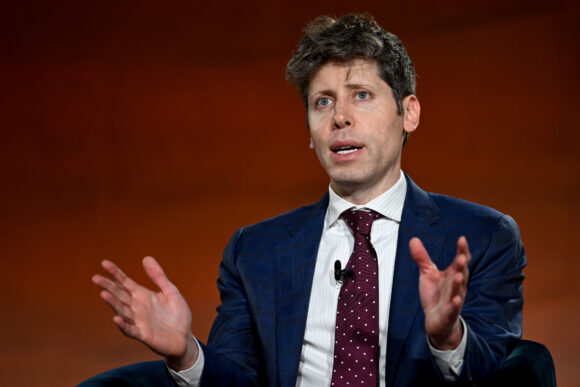
OpenAI CEO Sam Altman will push his vision for public-private collaboration on artificial intelligence during a visit to Washington on Wednesday, part of a broader policy agenda that also includes creating a vehicle to pass AI’s potentially vast financial windfall to consumers.
Altman was scheduled to visit the White House for discussions with U.S. officials, just a day after President Donald Trump called for AI companies to voluntarily share cutting-edge models for government review before their release. The OpenAI co-founder was also set to meet separately with Republican House Speaker Mike Johnson and Senator Bernie Sanders, an independent who’s aligned with Democrats, as lawmakers weigh a bipartisan framework on AI legislation.
While OpenAI praised Trump’s executive order for laying out a closer relationship between AI labs and government agencies, company staff including Chief Global Affairs Officer Chris Lehane cautioned Wednesday that many details on the directive remain unclear.
During a briefing with reporters in Washington, where he unveiled a new policy agenda, Lehane stressed that Altman would be discussing OpenAI’s ideas for how AI companies should work with the government during those White House meetings.
“Like any relationship my guess is it will evolve over time and will probably evolve as capabilities continue to evolve,” Lehane said of collaboration between the government and AI labs. “We think we’re going to need to even do more as we go forward.”
Altman’s meetings at the White House and on Capitol Hill are taking place as the maker of ChatGPT lays the groundwork for an initial public offering later this year that could value the company at nearly $1 trillion. Archrival AI developer Anthropic PBC filed confidentially for an IPO this week following a funding round that valued it at $965 billion.
The OpenAI chief has become a more frequent visitor to Washington as artificial intelligence emerges as a top policy issue for lawmakers and the Trump administration, stopping in the nation’s capital at least once per quarter, members of OpenAI’s staff said. Administration officials’ interest in the technology has surged following Anthropic’s disclosure in April that its new Mythos model had a knack for finding security gaps in computer systems and could pose a global cyber risk.
Those concerns prompted Trump to sign the order Tuesday aimed at addressing the risks of AI-enabled cyber attacks. The measure was spearheaded by White House Chief of Staff Susie Wiles, Treasury Secretary Scott Bessent and National Cyber Director Sean Cairncross. It’s unclear who Altman will meet from the administration, though ideas on how industry can collaborate with government will be on the agenda, Lehane said.
Under the order, U.S. officials have 60 days to develop classified benchmarks for determining whether a cutting-edge AI model is advanced enough to deserve submission for a voluntary government review. Over that same time period, they have to finish designing the voluntary framework. The government would have a maximum of 30 days of access to a new model before its release, but details such as which agencies would conduct voluntary reviews and what those reviews will entail remain unspecified.
That leaves the door open for OpenAI to influence the outcome as it engages with the White House, and the company’s policy document reveals some of their asks. Specifically, the company is vying for a larger role for the Commerce Department’s Center for AI Standards and Innovation and for more transparent disclosures from government model evaluations, per a blueprint for frontier model regulation published Wednesday.
OpenAI is also calling for more oversight over the possibility of models improving themselves, a process called recursive self improvement that would occur as the models are being built, rather than after they are completed.
As part of his Washington tour on Wednesday, Altman also plans to speak with Sanders about their shared goal of finding a way to distribute the wealth created by AI. In a New York Times op-ed this week, Sanders called for legislation to create what he called a sovereign wealth fund that would be financed with a one-time 50% tax on the stock of big AI companies, with the proceeds redirected as payments to the public.
“Sam is going to go see Senator Sanders today, presumably to have a conversation about this, and I just point to those developments as reflective of the fact that you are beginning to see like this conversation really taking hold,” Lehane said.
Also on the agenda is a meeting with Johnson, who’s overseeing ongoing AI regulation efforts in the House and who has expressed his disdain for the idea of a tax like the one Sanders has floated.
Top photo: OpenAI CEO Sam Altman. Bloomberg.
Was this article valuable?
Here are more articles you may enjoy.
 Storm Austen Knocks Out Power to Nearly 300,000 French Homes
  French Riots Seen as Insurance Test Before New Regime Kicks In
  Exxon Blocked Proposal to Settle $5 Billion Kashagan Dispute
  New York Arrests 16 in Crackdown on Staged Insurance Crashes
Want to stay up to date?
Get the latest insurance news
sent straight to your inbox.