
President Donald Trump said his administration has rescinded the “endangerment finding,” a landmark scientific determination that greenhouse gases pose a threat to human health and welfare.
“Under the process just completed by the EPA, we are officially terminating the so-called endangerment finding, a disastrous Obama-era policy that severely damaged the American auto industry, and massively drove up prices for American consumers,” Trump told reporters Thursday at the White House.
The 2009 determination serves as the legal foundation for a variety of environmental rules, including federal climate standards for cars and trucks. Trump said he was also repealing those vehicle-related standards.
“This action will eliminate over $1.3 trillion of regulatory cost and help bring car prices tumbling down dramatically,” Trump said. “You’re going to get a better car.”
The decision to repeal, which has been telegraphed for months, lays the groundwork for unwinding more federal climate regulations, according to industry experts. Thursday’s announcement, made alongside Environmental Protection Agency Administrator Lee Zeldin, marks the administration’s most consequential climate rollback, as well as its biggest deregulatory move.
This is the “single largest act of deregulation in the history of the United States of America,” Zeldin said.
Environmental groups, including the Natural Resources Defense Council and the Environmental Defense Fund, have pledged to challenge the decision in court. Repealing the EPA’s endangerment finding is “the single biggest attack in US history on federal authority to tackle the climate crisis,” said NRDC president Manish Bapna. “It is unscientific, bad economics, and it’s illegal.”
The decision comes roughly half a year after Zeldin first proposed it, a remarkably fast turnaround for a high-impact change that garnered more than 500,000 public comments.
“It is just ludicrous to think that we can actually have the EPA decide not to consider climate impacts at all when it’s been clearly made to be an essential component of how we have to regulate and it’s been done by the Supreme Court,” said Gina McCarthy, who served as EPA administrator for then-President Barack Obama.
The endangerment finding’s origins date back to a 2007 Supreme Court ruling on a case where the Bush-era EPA argued that the Clean Air Act didn’t cover greenhouse gases. The nation’s highest court ruled against the EPA at the time and ordered the agency to determine if those gases posed an environmental threat.
Ultimately, the EPA concluded that greenhouse gases were a threat — in the endangerment finding that the agency issued two years later during the Obama administration. This compelled officials to address global warming emissions from vehicles under the Clean Air Act. In 2010, the first greenhouse gas vehicle standards were issued.
NRDC’s senior attorney David Doniger said the latest move is an attempt to recycle the Bush administration’s arguments in hopes of getting the issue before a more sympathetic Supreme Court. At least three times since 2007, the Supreme Court has taken up challenges to EPA greenhouse gas rules, brought by fossil-fuel companies, climate skeptics and attorneys general in Republican-led states, and each time they declined to reconsider the original decision.
Back in September, three former EPA chiefs, including McCarthy, wrote to the agency voicing their opposition to repealing the endangerment finding. Many state and local officials, businesses and scientists pushed back as well. The U.S. National Academies of Sciences, Engineering and Medicine submitted a 137-report as a public comment, concluding that the evidence that greenhouse gases harm human health is “beyond scientific dispute.”
Trump’s announcement follows the agency’s decision to drop a longstanding policy of factoring in the monetary value of avoided deaths from reduced air pollution when drafting certain rules. Earlier this month, Trump also withdrew the U.S. from several key UN climate bodies working on global climate cooperation, including the Intergovernmental Panel on Climate Change and the UN Framework Convention on Climate Change.
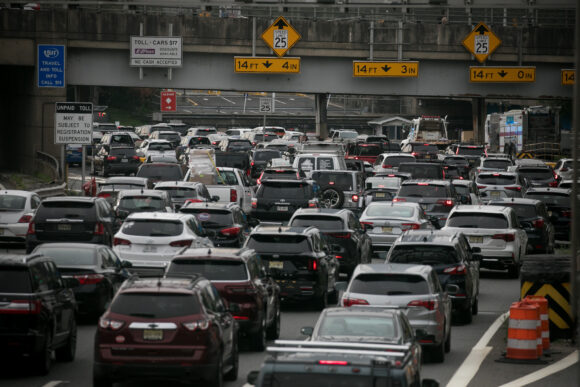
Top photo: Vehicles approach the George Washington Bridge in Fort Lee, New Jersey, on Monday, July 24, 2023. New York’s plan to charge drivers entering midtown Manhattan is a brazen money grab, New Jersey’s senior US senator said after the Garden State sued to block the congestion pricing proposal. Bloomberg.
Was this article valuable?
Here are more articles you may enjoy.
 Google Accused of Overcharging 20 Million Consumers in UK Class Action
  First Atlantic Hurricane of 2026 to Threaten US Gulf Coast
  Will California’s New Smoke Claims Law Create a Recovery Bottleneck?
  Slips, Trips And Falls: Why It’s Important to Get Ahead of An Incident
Want to stay up to date?
Get the latest insurance news
sent straight to your inbox.