
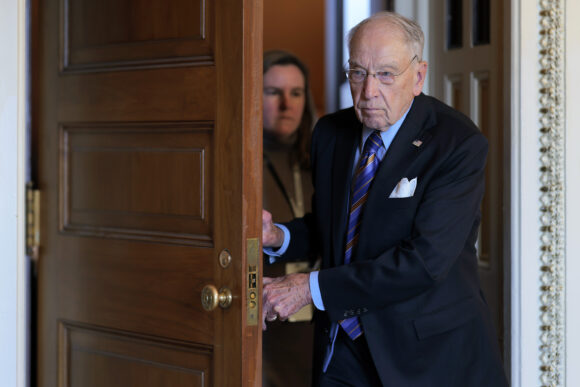
An investigation into ties between Credit Suisse and Nazi Germany has so far revealed hundreds of accounts with potential links to Nazi-era officials and industrialists, including the SS paramilitary wing, according to U.S. Senator Charles Grassley, adding to pressure on the bank ahead of a key hearing.
“These accounts were once used by individuals or entities who participated in or assisted Nazi war efforts,” including accounts for the German War Office, a German armaments manufacturer, and the German Red Cross, Grassley, chairman of the Senate Judiciary Committee, told journalists on the eve of Tuesday’s hearing in Washington DC.
Credit Suisse’s connection to these three entities was “previously unknown or only partly known,” and the investigation also “found evidence that Credit Suisse’s banking relationships with the Nazi SS was more extensive than we knew before,” he said.
The link to the SS’s economic arm, which profited from Jewish forced labor and concentration camps was revealed by a Swiss commission in the 1990s. But at the time “the bank stifled key details from investigators and the public,” said Grassley.
Tuesday’s hearing is the latest development in a six-year campaign by activists and politicians to force a reckoning for what they say are a trove of Swiss bank accounts that weren’t fully covered in probes leading to a landmark 1998 settlement. That agreement saw Swiss banks pay $1.25 billion for their handling of Holocaust victims’ accounts.
Nazi Sympathizers
The bipartisan campaign led by Grassley and Senator Sheldon Whitehouse stems from a 2020 report from the Simon Wiesenthal Center that it had discovered a list of 12,000 suspected Nazis or Nazi sympathizers in Argentina, a number of whom had contributed money to accounts at a predecessor bank of Credit Suisse as they fled at the end of World War II.
Grassley said he learned of this in 2023 when the bank dismissed Neil Barofsky as the independent ombudsman overseeing the investigation. Grassley began to put pressure on the Swiss bank, demanding to know why.
UBS Group AG, which inherited the Credit Suisse case when it bought its ailing rival from near collapse in March of that year, later reappointed Barofsky.
Robert Karofsky, the head of UBS’s Americas business, said that the bank has dedicated “immense resources” and spent “hundreds of millions” to help with Barofsky’s investigation, according to his prepared remarks shared ahead of the hearing.
“Our objective has been to undertake all measures to identify truly new information,” he continued. “We believe this is what Chairman Grassley refers to as “leav[ing] no stone unturned.”
A dispute however is emerging between what Barofsky says UBS should hand over from Credit Suisse’s archives and what UBS says is protected by attorney-client privilege.
There are around 150 documents, among more than 16.5 million UBS has shared, that it says it won’t hand to Barofsky because the Simon Wiesenthal Center and others have threatened litigation over this matter. That “makes it of paramount importance to protect those specific attorney communications,” Karofsky said.
Barofsky, who was picked in 2014 as Credit Suisse’s government-appointed monitor after it pleaded guilty to helping Americans evade taxes, is scheduled to testify on Tuesday. He is expected to provide some highlights from a 78-page interim report on the investigation and show that the investigations that led to the 1998 settlement weren’t adequate, according to Senate Judiciary Committee aides.
The forensic investigation is expected to wrap up by early summer, and then Barofsky is expected to complete his final report around the end of the year, they said. More leads remain to be probed, they noted, including UBS’s own history.
The focus of the Senate’s efforts is on ensuring the investigations are complete. But there have already been calls for additional restitution to victims based on the new revelations.
Ronald Lauder, the billionaire president of the World Jewish Congress, called on Switzerland and UBS to open all of its archives, facilitate an independent review and to commit to justice and restitution.
“The continued possession or concealment of such assets creates material legal and financial exposure under U.S. law,” the WJC said in a statement last week.
Lauder said in an interview last year that the 1990s deal drastically understated the bank’s actual exposure. UBS and Swiss officials counter that the agreement covers all potential new revelations.
Karofsky reiterated that point, stressing that the settlement was designed to achieve “global resolution through a conclusive end to the controversy that went beyond legal and financial closure” and “expressly includes ‘. . . any claims . . . hereafter arising or discovered . . . .'”
The Zurich-based bank needs to stay on the good side of US regulators as it pushes to expand its business managing money for rich Americans. UBS has evaluated the possibility of relocating outside Switzerland amid a row over capital requirements. The Americas represent both the largest single revenue source for the global wealth manager and a major strategic focus.
n active 2026 tornado season is expected for the Central Plains, with approximately 15% more tornadoes than the 20-year average, according to the Kansas Institute of Tornado Dynamics (KITD).
Factors influencing this forecast include persistent La Niña conditions, warmer-than-average Gulf of Mexico sea surface temperatures, and an intensified low-level jet stream.
Top photo: Sen. Charles Grassley. Bloomberg.
Was this article valuable?
Here are more articles you may enjoy.
 HSBC Executive Strikes Back in Court Fight Over Poaching Claims
  TikTok Accused by NY of Running Secret Safety Tests on Teens
  First Atlantic Hurricane of 2026 to Threaten US Gulf Coast
  Anxiety Over Gas Prices Points to ‘Looming EV Comeback’ in US
Want to stay up to date?
Get the latest insurance news
sent straight to your inbox.