
Officials say the 29-acre sinkhole in Louisiana’s Assumption Parish swallowed six cypress trees on March 26 and had its first deep burp of gas and fluid since late August.
The Advocate reports the event comes nearly two weeks after lead scientists investigating the sinkhole for state regulators said the hole seemed to be on the path to stabilizing.
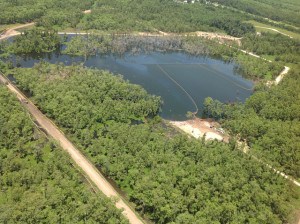
The sinkhole slowly pulled down six trees about 3:45 p.m. on the southwestern side of the lake-like hole, near an earthen well pad operated by Texas Brine Co.
“The trees went straight down this time,” said John Boudreaux, director of the parish Office of Homeland Security and Emergency Preparedness.
Hydrocarbons could be faintly smelled in the Bayou Corne community near the sinkhole, parish officials reported.
Boudreaux said the smell is likely from oil-saturated earth around the sinkhole being stirred up. At one time, the sinkhole was producing a crude-like fluid.
Boudreaux said the sinkhole edge collapse, known as a slough-in, followed Texas Brine’s recent efforts to reduce rising pressures in the failed salt dome cavern suspected of causing the sinkhole to form in August 2012.
Scientists believe the Texas Brine cavern was mined too closely to the outer face of the Napoleonville Dome, a massive salt deposit, and had a catastrophic wall collapse or breach that led to the sinkhole.
Was this article valuable?
Here are more articles you may enjoy.
 Agentic Intelligence for Claims Dominates New Tech Launches
  Report: Property Claims Face Delays, Are Growing More Complex
  UIM Minimum Limits. A Coverage That May Not Pay?
  Google Faces $3.2 Billion Damage Claims on Ad-Tech Monopoly
Want to stay up to date?
Get the latest insurance news
sent straight to your inbox.