
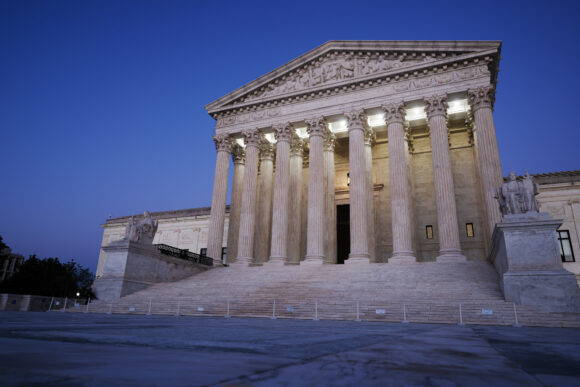
The U.S. Supreme Court asked the Trump administration for input on an appeal from pharmaceutical and medical-device companies that are trying to stop a lawsuit accusing them of helping to finance terrorist attacks in Iraq.
The companies are seeking review of a ruling that let American terrorism victims sue the companies for allegedly paying millions of dollars in bribes to secure medical-supply contracts with the Iraqi Ministry of Health from 2004 to 2013. The victims say the money went to Jaysh al-Mahdi, a militant group that controlled the ministry.
The lawsuit names units of AstraZeneca Plc, Roche Holding Ltd., GE HealthCare Technologies Inc., Johnson & Johnson, Pfizer Inc. and Viatris Inc. as defendants. The companies were sued by servicemembers and civilians who served in Iraq, as well as their families.
The justices directed their request Monday to U.S. Solicitor General D. John Sauer, the administration’s top Supreme Court lawyer.
The companies say they contracted with the ministry at the encouragement of the U.S. government. They told the Supreme Court that, even if true, the allegations against them weren’t sufficient to let a lawsuit go forward under the U.S. Anti-Terrorism Act.
The drugmakers said the suit didn’t allege a sufficiently close connection between their transactions with the ministry and specific acts of terrorism. The companies also contended the law requires a showing that a defendant intended to help a terror attack succeed.
In urging the Supreme Court to reject the appeal, the victims said the companies knew their bribes financed attacks and yet continued paying for years. A federal appeals court in Washington ruled the suit could go forward, saying the complaint adequately alleged that the companies repeatedly structured their transactions in an unusual and illegal manner that facilitated Jaysh al-Mahdi’s activities.
The Supreme Court ruled unanimously in 2023 that the Anti-Terrorism Act couldn’t be used to hold social media companies responsible for a 2017 shooting in an Istanbul nightclub. Both sides in the Iraq case contended the court’s reasoning in the 2023 case supported their arguments.
The case is AstraZeneca U.K. v. Atchley, 26-245.
Top photo: The US Supreme Court in Washington. Bloomberg.
Was this article valuable?
Here are more articles you may enjoy.
 Home-Renovation Expense Keeps Rising as Companies Pass on Costs
 Learjet Parts Found Miles From Florida Crash Site, NTSB Says
 California Homes Face Shutoffs as Santa Anas Raise Fire Risks
 Bayer Wins Roundup Trial as Settlement Decision Looms

Want to stay up to date?
Get the latest insurance news
sent straight to your inbox.