
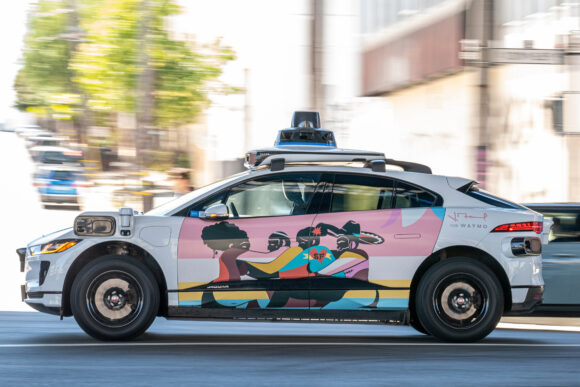
If there’s ever a robot uprising, it won’t be too difficult to decide what — rather than who—should be driving your ride out of town.
Waymo’s driverless cars crash less often than people do, a new report shows. And the comparison wasn’t even close.
Insurance Institute for Highway Safety researchers examined data on per vehicle mile traveled and found that Waymo’s driverless vehicles deployed in San Francisco, Phoenix, Los Angeles and Austin were involved in 68% fewer crashes than human drivers. The sample was restricted to crashes that a person would typically report to the police.
Waymo is Alphabet’s self-driving car project, which has been operating robotaxi service to varying degrees in a few cities since 2020. Its vehicles are classified as Level 4 on the automation scale, so the Waymos do all the driving with no human supervision under certain conditions.
Related: Waymo Suspends Service in Atlanta as Robotaxis Stumped by Floods
“I think it’s fair to say they have lower crash rates than humans in the areas they operate and there’s a lot of ways to measure safety, but crash rates is a really important one,” said Eric Teoh, IIHS’ director of statistical services, who authored the study. “At the end of the day, they are having lower crash rates than humans are, and that’s good.”
Waymos don’t eat while steering with one hand or a knee, chat on their cellphones as they turn left into oncoming traffic or spin around to yell at the kids in the back seat. Could those be the sort of reasons why Wamos are outperforming humans?
“I think that’s literally correct,” Teoh said. “They also they don’t get distracted, they also don’t get drunk, and to our knowledge, they don’t speed.”
When looking at the crash data, Teho gives the advantage to Waymo in nearly all type of crashes the IIHS examined, including more dangerous incidents, like head-on collisions and T-bone crashes.
“They have never run off the road into trees, you know things that humans do sometimes,” he said. “So, I think that in addition to having lower rates of overall crashes, they’re also, we can say, getting into less egregious types of crashes.”
Waymo vehicles traveled 50 million miles in driverless operation over the study period compared with 222 billion miles by humans over the same period and in those locations.
The Waymos’ crash involvement rate was 68% lower than human drivers overall, and it was even better in Phoenix, where it was 76% lower. In the commuter sanctum of Los Angeles, it performed 71% better. It was 35% lower in San Francisco, and 4% higher in Austin. The low figure in Austin comes from a small sample size, according to IIHS.
Additionally, Waymos were involved in 85% fewer single-vehicle crashes and 81% fewer injury crashes per vehicle mile traveled than human drivers, the data shows.
Related: US Takes Aim at Autonomous Car Mishaps in Safety Rulemaking Push
The National Highway Traffic Safety Administration began requiring reporting in 2021 under a Standing General Order on crash reporting for incidents involving automated driving systems that result in fatalities, injuries or property damage. While other tracking databases exist for self-driving vehicles, the SGO database is the only national data collection tool for crashes involving self-driving vehicles. For this reason, it was a key resource of data for the IIHS in its study.
While AV companies are required to report crashes, they are not obligated to report the miles they log or whether such miles involved a human driver. Waymo provides driverless vehicle miles traveled information voluntarily, other companies, including AV makers that use partial human involvement or supervision, do not. That makes it impossible to know how common it is for their vehicles to crash, and it makes a direct comparison with the crash rates of humans difficult to account for the differences between the reports required by the SGO and what humans report, the IIHS researchers found.
Using what they call “a common-sense standard,” IIHS researchers estimated that only 22% of the 736 public-road crashes in which the automation was engaged were likely police-reportable: 89 crashes involving Waymos, 50 involving Cruise vehicles, 10 involving Zoox vehicles and 10 involving others. Because mileage numbers were only available for Waymo, the researchers used its crashes to calculate self-driving vehicle crash rates. Of Waymo’s 89 police-reportable crash involvements, 64 were in driverless operation, and the others involved supervised use of the automation, according to the study.
The report calls for better national data as more and more AVs roll out, noting that “the present data collection system isn’t good enough to allow continuous monitoring of a large-scale expansion” of AVs and robotaxis.
Waymo was reached for comment. It said the IIHS data validates its own previous analysis of the first 56.7 million miles of fully autonomous driving data, which showed Waymo vehicles were involved in 79% fewer injury crashes compared with human drivers.
“We welcome this new research from IIHS, which confirms our previous peer-reviewed analyses and reinforces the significant safety benefits of the Waymo Driver. We also support the authors’ recommendation for more robust reporting requirements for AV operators — requirements that Waymo already voluntarily meets,” a comment provided via email by a Waymo spokesman states. “This study is an important contribution to a growing body of research on AV safety data, and we’re looking forward to additional analyses from the scientific community. More high-quality data is fundamental for building public trust in this technology, and ultimately making roads safer for everyone.”
This is a definitely a point in favor of AVs and robotaxis that have only begun dipping their toes into the waters of the nation’s highways and roads, and the IIHS findings may provide some comfort to the makers of the vehicles. Until now, there’s been an abundance of negative reports about AV goofs and robotaxis gone wild.
The head of NHTSA said in July that self-driving car companies need to quickly address a “clear pattern” of driverless vehicles interfering with law enforcement and other first responders.
Jonathan Morrison said in a letter to the industry that NHTSA has documented multiple instances of AVs driving into active emergency scenes, and other incidents when the vehicles “blocked the paths of ambulances and firefighters, or failed to recognize and respond to basic safety conditions like flashing lights, flares, smoke, fire, and traffic cones.”
Waymo recalled nearly 3,900 U.S. robotaxis in June over a software issue that could cause the vehicles to enter a closed freeway construction zone and continue driving. It is the second recall by Waymo in just over a month. Waymo in May recalled thousands of robotaxis to fix a software issue that could cause the AVs to drive on flooded roads.
Those and other incidents prompted the Trump administration to announce it is working to develop new safety requirements governing how AVs vehicles behave on the road.
Top photo: A Waymo autonomous taxi in San Francisco, California, on Aug. 10, 2023. Photo by AP.
Was this article valuable?
Here are more articles you may enjoy.
 Hackers Tricked Asos Employee to Steal Work Account Login
  Recovery Starts Before the Loss: What Claims Professionals Know About Severe Weather Preparedness
  Will California’s New Smoke Claims Law Create a Recovery Bottleneck?
  Tesla Drops ‘Self-Driving’ Branding to Appease Europe Regulators
Want to stay up to date?
Get the latest insurance news
sent straight to your inbox.