
The U.S. Transportation Department said last Wednesday it is rescinding part of its long-standing civil rights regulations that prohibit conduct that has an unintended “disparate” impact.
In April 2025, President Donald Trump ordered federal agencies not to enforce laws that prohibit policies and practices with discriminatory impacts that are often unintended.
U.S. Transportation Secretary Sean Duffy said the department is making clear its regulations “prohibit only intentional discrimination, not conduct or activities that have a disparate impact,” and added USDOT will not take action on disparate-impact liability.
Curbing so-called disparate impact liability, which is common in employment-related cases, removes a tool the government has used for decades to also police discrimination in housing, education, lending and other areas.
Federal Discrimination Laws Date to Civil War
On June 9, the Justice Department said the Equal Employment Opportunity Commission’s legal guidance to deter disparate impacts on protected groups of workers is wrong because it focuses solely on outcomes with no regard for an employer’s intent.
Numerous federal laws, some dating back to the years after the Civil War, prohibit discrimination based on race, sex, religion and other protected traits. Courts long understood discrimination to be an intentional act, but that began to change after the adoption of the landmark Civil Rights Act in 1964.
The U.S. Supreme Court in a 1971 case said that otherwise neutral employment practices can violate Title VII of the Civil Rights Act when they disproportionately affect a protected group and are not demonstrably related to job performance.
Examples of policies that can have disparate impacts include fitness requirements that are more difficult to meet for women or people with disabilities, and requirements that new hires be recent college graduates, which rules out many older applicants.
Trump and other critics of disparate-impact liability have said the threat of litigation prevents businesses from making decisions based on merit and skill, and that the legal theory wrongly presumes that unlawful discrimination exists where there are any disparities in outcomes among different groups.
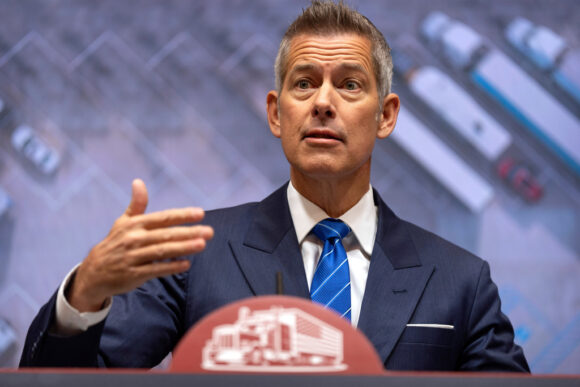
Photo: Transportation Secretary Sean Duffy speaks during a news conference at the Department of Transportation in December, 2025. (AP Photo/Mark Schiefelbein)
Was this article valuable?
Here are more articles you may enjoy.
 Isaias: 47,000 Claims and $582M in Losses in Florida So Far, OIR Reports
  Psychological Reactance: The Hidden Bias in Claims Negotiation
  Money Managers Say There’s Nowhere to Hide as Super El Niño Forms
  Apple-OpenAI Judge Says He’s ‘Likely’ to Side With iPhone Maker
Want to stay up to date?
Get the latest insurance news
sent straight to your inbox.