
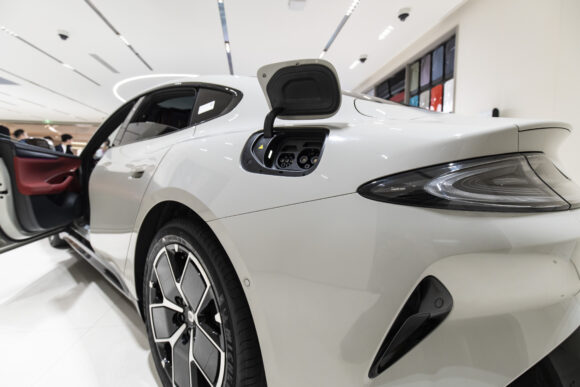
A fatality involving a Xiaomi Corp. SU7 electric sedan has renewed scrutiny of flush car door handles and is likely to reinforce China’s push for tougher safety standards.
Bystanders were unable to open the doors to rescue the driver, who died after the vehicle burst into flames following Monday’s collision that police suspect was caused by drunk driving.
While Chinese regulators began drafting new requirements for door handle mechanisms after a similar crash in March killed three people, analysts expect the latest incident to bolster the case for implementation as it reignites debate over EV door handle design in China.
A hashtag on this topic was trending on Weibo, the Chinese social media platform, and was viewed more than 1 million times.
In September, the Ministry of Industry and Information Technology proposed regulations requiring all passenger vehicles to feature mechanical door releases accessible from both inside and outside the car. The rules aim to eliminate recessed or hidden handles popularized by Tesla Inc.
“The Xiaomi EV accidents have sped up the arrival of the new car door handle national standards,” said Li Yanwei, an adviser to the China Automobile Dealers Association. Carmakers with models featuring flush handles will “need to improve their products to comply with the new standards.”
Flush door handles, now seen across a range of vehicle types, were popularized by EVs as a sleek, futuristic design. Though China’s proposed rules will apply only to vehicles sold domestically, its position as the world’s largest car market means global automakers will likely need to redesign models to comply, potentially reshaping industrywide design standards.
Tesla Handles
Tesla is also under scrutiny in the U.S., with the National Highway Traffic Safety Administration having launched a defect investigation into certain Model Y door handles. The agency initiated the probe days after a Bloomberg News report uncovered a series of incidents in which people were injured or died after they were unable to open doors when the cars lost power.
China’s draft rules allow for electrically powered handles but mandate that doors must be operable from the outside without tools, even if the locking system is engaged or the battery overheats. Mechanical release is defined as a system that operates solely through physical connections, without electrical signals. The handle must also provide a hand space of at least 6 centimeters by 2 centimeters.
Additional requirements include performance testing under various conditions. The proposal is open for public feedback until Nov. 22, and automakers would have 19 months to update models already in the pipelines once the rules, scheduled to take effect in 2027, are finalized.
Some manufacturers are already adapting. Zeekr’s 9X sport utility vehicle, for example, features traditional-style handles with electrical functionality that meet the draft requirements.
“This is a return to common sense,” said Yale Zhang, the managing director of Shanghai-based consultancy Automotive Foresight, referring to the draft safety standard.
Top photo: A Xiaomi Corp. SU7 electric vehicle Photographer: Qilai Shen/Bloomberg.
Was this article valuable?
Here are more articles you may enjoy.
 PG&E Warns of Possible Weekend Power Shutoffs Amid Windy Weather
  TikTok Accused by NY of Running Secret Safety Tests on Teens
  Hackers Tricked Asos Employee to Steal Work Account Login
  UIM Minimum Limits. A Coverage That May Not Pay?
Want to stay up to date?
Get the latest insurance news
sent straight to your inbox.