
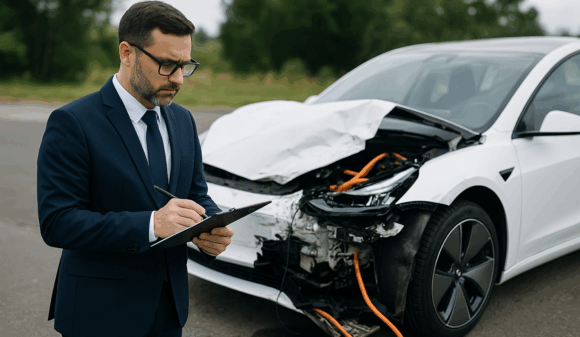
As the automotive landscape evolves, it has become important to distinguish between electric vehicles and hybrid electric vehicles in comparison to traditional internal combustion engine vehicles.
EVs are powered entirely by electricity and rely on high-voltage battery systems, while HEVs combine an internal combustion engine with an electric propulsion system. Understanding the differences between these vehicle types is essential for damage estimators, as each presents unique repair challenges, safety considerations and diagnostic procedures. The EV is reshaping not just the auto industry but also the insurance and collision repair sectors.
The EV-SC.org (Electric Vehicle Standardization Council), a collaborative initiative focused on developing and promoting standards for electric vehicle repair, diagnostics, and damage assessment, has established peer-reviewed standards for EV technicians. Subsequent to this initiative, the EV-SC board sought to model the work being done for technicians and apply it to estimators, those that identify if and how an EV would be repaired and provide an accurate cost for the repair after a collision.

As a founding board member, Vale Training took the lead to design a program to address the role of an estimator today and prepare for the future. This work is especially relevant for insurance carriers and their customers who face growing complexity navigating the repair process to arrive at safe, complete and cost-effective repairs. The focus of the training program is to ensure estimators are equipped to handle both EVs and HEVs with precision and confidence. And an eye to the future.
Establishing standardized procedures for assessing damage in electric vehicles, given their complexity, is essential.
As the market for EVs continued to grow, data from the Alliance for Automotive Innovation research shows that more than 125 models of plug-in hybrid (PHEV), fully electric (BEV), and fuel cell electric vehicles (FCEV), are available to consumers—and more are on the way. More than 150 models are expected to be on the market by 2026. Automakers are providing our customers with record-breaking choices in energy-efficient models, while also providing even safer, more environmentally friendly, affordable vehicles.
The automotive industry is investing more than $1.2 trillion by 2030 in its commitment to vehicle electrification. EVs are an important part of our mission, both in the U.S. and around the world.
The EV Repair Challenge: Complexity and Risk
One of the most significant hurdles in EV damage assessment is the high-voltage battery system. It’s not just a technical component; it’s a safety risk and a financial wildcard. Improper handling or misdiagnosis can lead to unnecessary total loss declarations, costly replacements or even injury.
In Vale’s training program, estimators learn how to safely de-energize EVs, assess battery integrity, and follow OEM procedures for high-voltage components. This knowledge is essential for avoiding premature total loss decisions and ensuring repairs are both safe and economically viable.
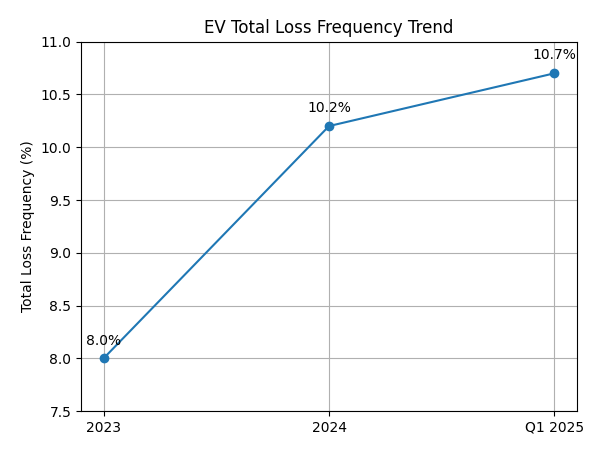
Recent data underscores the urgency of this training. According to Mitchell International, EV total loss frequency rose to 10.7% in the first quarter of 2025 in the U.S., a 33% increase from 2023.
These trends highlight the growing need for specialized training. EV repair costs are now 20% to 30% higher on average than those for ICE vehicles. This increase is largely due to falling used EV values and rising repair costs, particularly for battery packs and advanced driver assistance systems (ADAS) components.
From 2016 through 2025 (Q2), traditional internal combustion engine ICE market share steadily declined, according to the Alliance for Automotive Innovation Get Connected EV Quarterly Report. In 2016, ICE vehicles comprised more than 97% of all vehicle sales. Through the second quarter of 2025, year-to date ICE share dropped to 73.5% for an overall loss of 23.7%.
Beyond safety and cost control, the ability to repair rather than replace is a key driver of operational efficiency. A trained estimator can quickly identify whether a damaged EV component, be it a sensor, software module or battery cell that can be repaired or must be replaced. This precision reduces labor hours, minimizes rework and streamlines parts ordering.
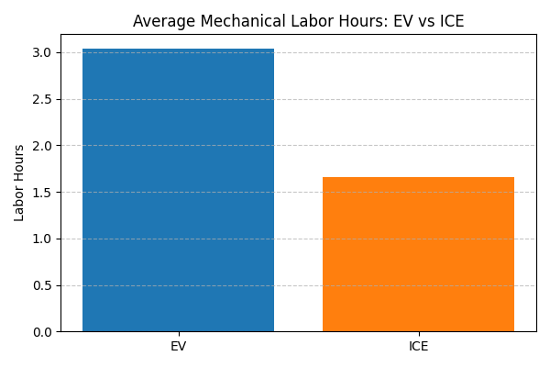
Mitchell’s data shows that EV repairs require nearly twice the mechanical labor hours compared to ICE vehicles (3.04 hours vs. 1.66 hours). Without proper training, these hours can balloon further due to diagnostic uncertainty and procedural errors. Training can help estimators standardize workflows and provide a rough estimate on repair times, enabling technicians to move from diagnosis to repair with confidence and speed.
This efficiency translates directly into shorter cycle times—a metric that matters deeply to both insurers and customers. According to CCC Intelligent Solutions, rising vehicle complexity is already extending repair timelines, and EVs are amplifying this trend. Equipping estimators with EV-specific knowledge helps mitigate delays.
The Cost of Delay
Cycle time isn’t just a shop metric—it’s a customer experience issue. Every day a vehicle sits in the shop is another day the insurer pays for a rental car and the customer remains inconvenienced. With EVs, these delays can be even more costly due to limited parts availability and specialized repair requirements.
Loss of use costs are rising across the board. While exact figures vary by region and insurer, industry reports show that the average cost of repair—including rental expenses—continues to climb due to inflation, parts shortages, and labor constraints. For insurers, reducing these costs starts with accurate, timely estimates—and that begins with trained estimators.
Customer satisfaction is also at stake. Research from Loop in 2025 showed that EV buyers report significantly lower satisfaction scores during the sales and service process compared with ICE vehicle owners—17.5 points lower, to be exact. While this data focuses on the dealership experience, it reflects a broader trend: EV customers expect more, and they’re less forgiving of delays and missteps.
Targeted training helps insurers and repair shops meet these expectations. By reducing supplemental claims and improving first-time repair accuracy, the enhanced EV training supports a smoother claims journey, one that builds trust, loyalty and retention.
Why Estimators Matter More Than Ever
The rise in total loss declarations is one of the most pressing issues facing the industry. CCC’s data shows that total-loss frequency has climbed toward 20% to 22% of auto physical damage claims in recent years. For BEVs, Mitchell reports a total-loss frequency of 10.2% in 2024, up from 8% in 2023.
The rise in total loss declarations is one of the most pressing issues facing the industry. These decisions are often influenced by the complexity of EV systems, especially when battery damage is involved. Estimators must understand how to evaluate these components accurately to avoid unnecessary total loss outcomes. By accurately assessing battery damage and understanding repair options, estimators can prevent unnecessary total loss decisions by saving insurers thousands per claim and keeping vehicles on the road.
A Strategic Investment in the Future
According to industry forecasts, EVs are expected to comprise more than 30% of new vehicle sales by 2030. This rapid adoption means that claims professionals must be prepared not only for today’s challenges but also for tomorrow’s innovations.
Dell is a vice president, executive leader learning & development, with Sedgwick.
Was this article valuable?
Here are more articles you may enjoy.
 ‘Unusual’ Isaias Brings Winds, Downed Trees But Fewer Claims Than Expected
  Exxon Blocked Proposal to Settle $5 Billion Kashagan Dispute
  TikTok Accused by NY of Running Secret Safety Tests on Teens
  Hordes of Teens on E-Bikes Force Suburbs to Rewrite Road Rules
Want to stay up to date?
Get the latest insurance news
sent straight to your inbox.