
The U.S. Supreme Court refused to take up a new test of “qualified immunity,” rejecting several appeals that challenged the legal doctrine that has become a broad liability shield for police officers accused of civil rights violations.
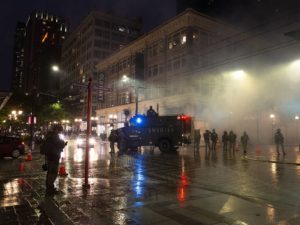
Qualified immunity has come under renewed scrutiny in recent weeks amid the nationwide protests sparked by the May 25 death of George Floyd and the video of a Minneapolis police officer kneeling on Floyd’s neck for more than eight minutes.
Under a decades-old line of Supreme Court rulings, qualified immunity shields police officers and other government officials from personal liability unless they violate a “clearly established” right. As a practical matter, that standard has come to mean that officials can be held liable only if a court in their jurisdiction has considered an almost identical case and declared the conduct to be illegal.
Several justices have expressed interest in overhauling the qualified immunity doctrine. Justice Sonia Sotomayor has been the most critical, saying in a 2018 dissent joined by Justice Ruth Bader Ginsburg that the court’s approach had created “an absolute shield for law enforcement officers.”
Justice Clarence Thomas has also been critical, though for different reasons. Thomas wrote in 2017 that the court should apply the immunity principles that courts recognized in 1871, when Congress enacted the civil rights law that lets people sue government officials for damages for violating federal law.
Was this article valuable?
Here are more articles you may enjoy.
 Google Accused of Overcharging 20 Million Consumers in UK Class Action
  Anxiety Over Gas Prices Points to ‘Looming EV Comeback’ in US
  Agentic Intelligence for Claims Dominates New Tech Launches
  Warren, Hawley Press Insurers Over Closed, Unpaid Claims
Want to stay up to date?
Get the latest insurance news
sent straight to your inbox.